| Lesson 8 | Global e-commerce |
| Objective | Identify challenges associated with doing business globally on the Internet. |
Global E-Commerce Business
The global nature of the Web means that a company doing business online can become international by default. A business may begin with a local or national customer base, but search engines, social media, online advertising, marketplaces, and payment platforms can make its products visible to customers in other countries. This creates opportunity, but it also creates operational responsibility.
A global e-commerce site is not simply a domestic web store that receives visitors from other countries. It is a business system that must coordinate marketing, language, currency, payment processing, shipping, customs, tax rules, customer service, fraud prevention, privacy expectations, and regional design conventions. Before encouraging international sales, a company should decide which markets it wants to serve, which markets it is prepared to support, and which markets it may need to restrict.
Doing business globally requires more than a translated product page. International customers may expect local currency, familiar payment methods, clear shipping costs, predictable delivery dates, return instructions, multilingual support, and customer service that operates across time zones. Web developers, marketers, logistics providers, payment processors, and business managers must therefore work together. In global e-commerce, the website is both a marketing interface and a business operations platform.
Global Marketing
Global marketing requires sensitivity to local customers. A message that works well in one country may be unclear, ineffective, or inappropriate in another. Site content, images, navigation labels, calls to action, product descriptions, payment language, and customer support information should be written with the target audience in mind.
The goal is not to design one perfect website that fits every culture. That is usually impossible. The more practical goal is to design a flexible website that can be localized for selected regions. Localization means adapting content, layout, currency, units of measure, payment options, customer service expectations, and legal notices for a specific market. Internationalization means designing the software and content structure so that localization is possible without rebuilding the entire site.
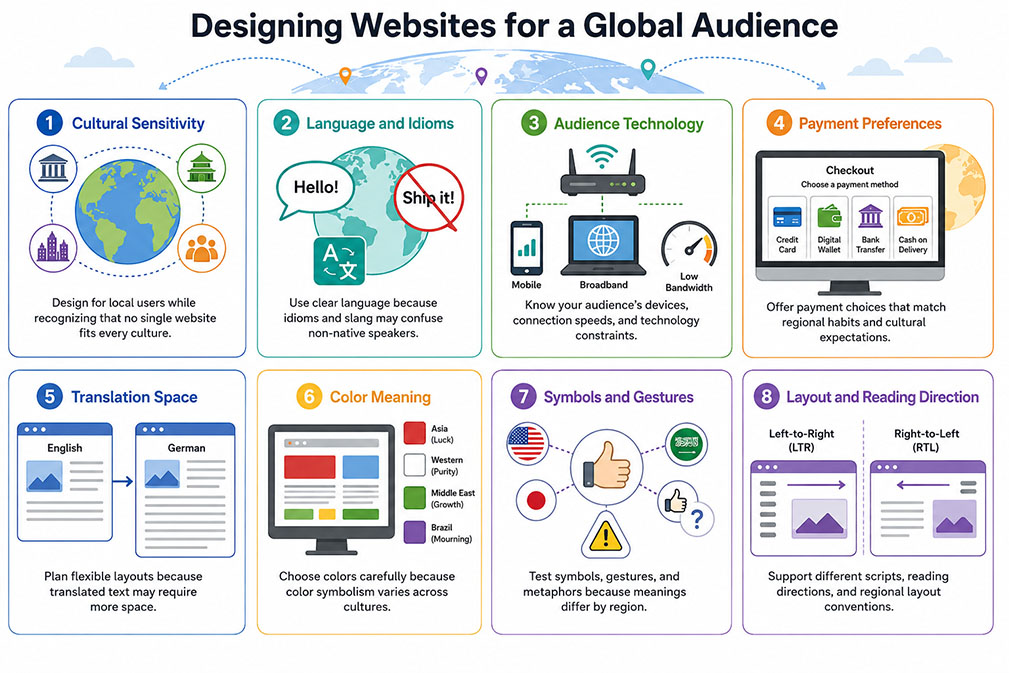
Eight Global Web Design Considerations
The legacy slideshow for this lesson presented several issues that designers should consider when creating a website for a global audience. Those ideas remain useful, but the examples should be understood in a modern web development context.
Cultural Sensitivity
A website cannot accommodate every global culture with a single design. However, designers should avoid assuming that all customers interpret visual elements, examples, humor, colors, symbols, business language, and page structure in the same way. Cultural sensitivity begins with recognizing that users bring different expectations to the site.
For example, images of buildings, families, business meetings, clothing, food, gestures, or holidays may communicate different meanings in different regions. A global e-commerce site should use visuals carefully and test regional pages with people who understand the target market. When necessary, the site can use localized landing pages for specific countries or languages.
Language and Idioms
Clear language is essential for international customers. Idioms, slang, jokes, abbreviations, and culture-specific phrases can be difficult for non-native speakers to understand. A phrase that seems friendly in one region may sound confusing or unprofessional in another.
Global web content should use direct headings, clear product descriptions, simple form labels, and unambiguous calls to action. Instructions such as "add to cart", "continue checkout", "confirm payment", and "request return authorization" should be easy to translate and easy to understand. Plain language also improves accessibility, search visibility, and machine translation quality.
Audience Technology
Global audiences do not all use the same devices, browsers, screen sizes, or connection speeds. Some customers may use high-speed fiber connections and large desktop monitors. Others may rely primarily on mobile phones, shared devices, prepaid data plans, or slower networks. A site that loads quickly in one market may perform poorly in another.
Modern global e-commerce design should therefore include responsive layouts, mobile-first design, compressed images, efficient CSS and JavaScript, reliable hosting, caching, and content delivery networks. The older concern about whether customers used dial-up, DSL, or dedicated T1 service should be updated to a broader performance question: can the site remain usable across modern broadband, mobile, low-bandwidth, and international network conditions?
Payment Preferences
Attitudes about money and payment methods are often regional. In some markets, customers commonly use credit cards. In others, they may prefer digital wallets, bank transfers, invoice payments, cash-on-delivery, local payment networks, or marketplace-based payment systems. A payment method that is normal in one country may be uncommon or distrusted in another.
A global e-commerce site should provide payment options that match the expectations of the target market. The checkout process should clearly show the currency, total cost, taxes, shipping fees, refund terms, and payment confirmation. Payment trust is especially important when customers are buying from a company located in another country.
Translation Space
Translated text may require more space than the original English text. A button, menu item, form label, error message, or product description may become longer after translation. German, French, Spanish, and many other languages can expand beyond the original English phrase. Some scripts also require different font handling or line spacing.
Layouts should be flexible enough to handle longer text without breaking the page. Designers should avoid fixed-width buttons that only fit English labels. Navigation menus, product cards, checkout screens, and customer support forms should be tested with translated text before the site is deployed.
Color Meaning
Color can carry different meanings across cultures. A color associated with celebration, trust, danger, wealth, purity, mourning, or luck in one region may suggest something different in another. Designers should not assume that color symbolism is universal.
Color choices should support usability first. Important messages such as errors, warnings, success confirmations, and required fields should not depend on color alone. Text labels, icons, and accessible contrast should reinforce the meaning. For regional campaigns, color palettes should be reviewed for cultural appropriateness.
Symbols and Gestures
Symbols, gestures, and metaphors may also vary by country. A thumbs-up gesture, hand signal, animal image, religious symbol, or metaphorical icon may be positive in one region, meaningless in another, and offensive somewhere else. Even common interface symbols can create confusion if they are not paired with text.
A global website should use simple, well-tested iconography and provide text labels where clarity matters. Designers should be especially careful with gestures, humor, stereotypes, flags, and culturally loaded imagery. The purpose of an icon is to clarify the interface, not to introduce ambiguity.
Layout and Reading Direction
Some languages read from left to right, while others read from right to left. Global websites may need to support different writing systems, scripts, text expansion patterns, calendars, date formats, address formats, phone number formats, and name structures. These issues affect forms, navigation, product pages, checkout screens, and confirmation messages.
This is why internationalization should be considered during site architecture and not added only at the end of development. A site that stores text separately from layout code, supports Unicode correctly, uses flexible templates, and avoids hard-coded assumptions will be easier to adapt for additional languages and regions.
Global Marketing Issues
Global marketing has changed dramatically because customers now interact with companies through search engines, social media, mobile apps, online marketplaces, email campaigns, review platforms, and personalized advertising systems. A global customer may discover a product through a search result, compare it through a marketplace, inspect reviews on a social platform, and complete the purchase through a mobile checkout page.
This means that marketing technology must be coordinated with e-commerce technology. Product data, pricing, inventory, landing pages, analytics, customer segmentation, advertising campaigns, and customer service systems should support the same business strategy. A company may manage the brand globally, but still adapt language, offers, shipping promises, and support details to local markets.
Modern global marketing also requires sensitivity to privacy expectations and regulatory limits. Tracking, personalization, email marketing, cookie notices, and customer data collection must be handled carefully. A marketing campaign that is technically possible may not be appropriate or compliant in every country.
Disruptive Technologies
Earlier e-commerce discussions often treated social media, mobile apps, and digital payments as disruptive technologies. Today, those technologies are part of the normal commercial environment. The disruption now comes from the pace at which customer expectations change. Customers expect fast pages, mobile-friendly checkout, accurate inventory, secure payment, order tracking, personalized recommendations, and responsive customer support.
For a global business, these expectations must be met across regions. A marketing team may use search advertising, social media campaigns, analytics platforms, customer data platforms, and automation tools. However, these tools must be connected to accurate product information, localized content, payment systems, fulfillment systems, and customer service workflows.
The practical challenge is balancing global consistency with local adaptation. A company wants a recognizable brand and a consistent technical platform, but it also needs the flexibility to support local payment methods, language differences, regional promotions, and local legal requirements.
Currency Rates and Payments
Currency exchange rates can affect pricing, profit margins, refunds, and customer expectations. The exchange rate at the time of purchase may differ from the exchange rate at the time of return. If a customer buys in one currency and receives a refund later, the business must decide how currency differences will be handled.
A global e-commerce site should display prices clearly and explain whether taxes, duties, shipping, and currency conversion fees are included. Customers should not discover unexpected charges only after they begin checkout. Clear pricing reduces abandoned carts and customer service disputes.
Payment processing also introduces fraud and risk management concerns. Credit card networks, digital wallet providers, payment gateways, merchant accounts, and fraud detection systems can help reduce risk, but they do not remove the need for clear business policies. The site should confirm successful payment, provide order receipts, and communicate refund rules in language the customer can understand.
Shipping, Handling, Customs, and Returns
International shipping is more complex than domestic delivery. It may involve carriers, freight services, warehouses, customs declarations, duties, taxes, restricted goods, delivery tracking, damaged goods, lost packages, and return logistics. A business that sells globally must know whether it can deliver reliably to the countries it accepts orders from.
Experienced logistics providers and third-party fulfillment services can help manage international delivery. However, the website must still communicate shipping costs, estimated delivery dates, return conditions, and customer responsibilities. If duties, taxes, or customs fees may be charged after purchase, the customer should know that before placing the order.
Returns are especially important. Return shipping may be expensive, slow, or unreliable in some regions. A clear return policy should explain how returns are authorized, who pays return shipping, how refunds are calculated, whether currency exchange rates affect the refund, and how damaged or lost shipments are handled.
Import and export regulations, tax rules, consumer protection laws, and product restrictions can change. Businesses should monitor the rules for the countries in which they operate and seek qualified legal, tax, payment, and logistics guidance when entering new markets.
Customer Service
Customer service is a central part of global e-commerce. International customers may need help in different languages and time zones. They may also have different expectations about response time, refund procedures, phone support, chat support, and written documentation.
A global e-commerce site should provide clear information about shipping, security, returns, refunds, product details, order tracking, customer support hours, contact forms, email addresses, and telephone numbers where appropriate. If support is available only in certain languages or during certain hours, the site should say so.
Good customer service reduces uncertainty. This is especially important when a customer is buying from a company in another country. The more unfamiliar the company is to the customer, the more important it becomes to provide transparent policies, accurate product information, secure checkout, and accessible support.
Conclusion
Global e-commerce creates opportunity, but it also expands the responsibilities of the business. A company that sells online must think beyond the visual design of the website. It must consider language, culture, payment methods, currency exchange, fraud prevention, fulfillment, customs, tax rules, legal requirements, and customer service.
For web developers, the key lesson is that technical decisions and business decisions are connected. Responsive design, localization-ready templates, payment gateway integration, performance optimization, accessible forms, secure checkout, and clear content all support the same goal: helping customers from different regions understand the offer, trust the business, complete the transaction, and receive support after the sale.
The next lesson concludes this module by reviewing the major concepts involved in developing and managing e-commerce websites.