| Lesson 2 | Conducting business using the Internet |
| Objective | Define types of Internet Business Models |
Conducting Business using the Internet
Ecommerce has fundamentally changed the nature of commercial transactions, reshaping how companies interact with consumers, with other businesses, and with the infrastructure that supports trade. A business that once required a physical storefront, a regional sales force, and a printed catalog to reach customers can now accomplish all of those things through a well-architected website. The shift is not merely one of convenience — it represents a structural change in how markets operate, how prices are set, and how buyers and sellers find each other.
As online commerce has matured, three distinct categories of ecommerce environment have emerged. Business-to-business (B2B) ecommerce connects companies to their suppliers, distributors, and institutional buyers through automated procurement and invoicing systems. Business-to-consumer (B2C) ecommerce connects retailers directly to individual shoppers through product catalogs, shopping carts, and consumer payment processing. Consumer-to-consumer (C2C) ecommerce connects private individuals to each other through marketplace platforms that provide the infrastructure for peer transactions. Each environment operates under different assumptions about who the buyer is, what they need, and how trust and payment are established between the parties.
Within these environments, specific functional designs — commonly called Internet business models — have developed to address different commercial goals. Some models are straightforward, such as a company publishing product information with no online transaction capability. Others are complex ecosystems involving multiple parties, automated pricing, real-time inventory management, and global fulfillment networks. Understanding these models is foundational knowledge for web developers, because the business model a client adopts directly determines the architecture, features, database requirements, and performance targets of the site that must be built to support it.
The diagram below illustrates seven of the most common functional models used in ecommerce site design, ranging from the simple one-way marketing brochure to the complex metamediary virtual mall.
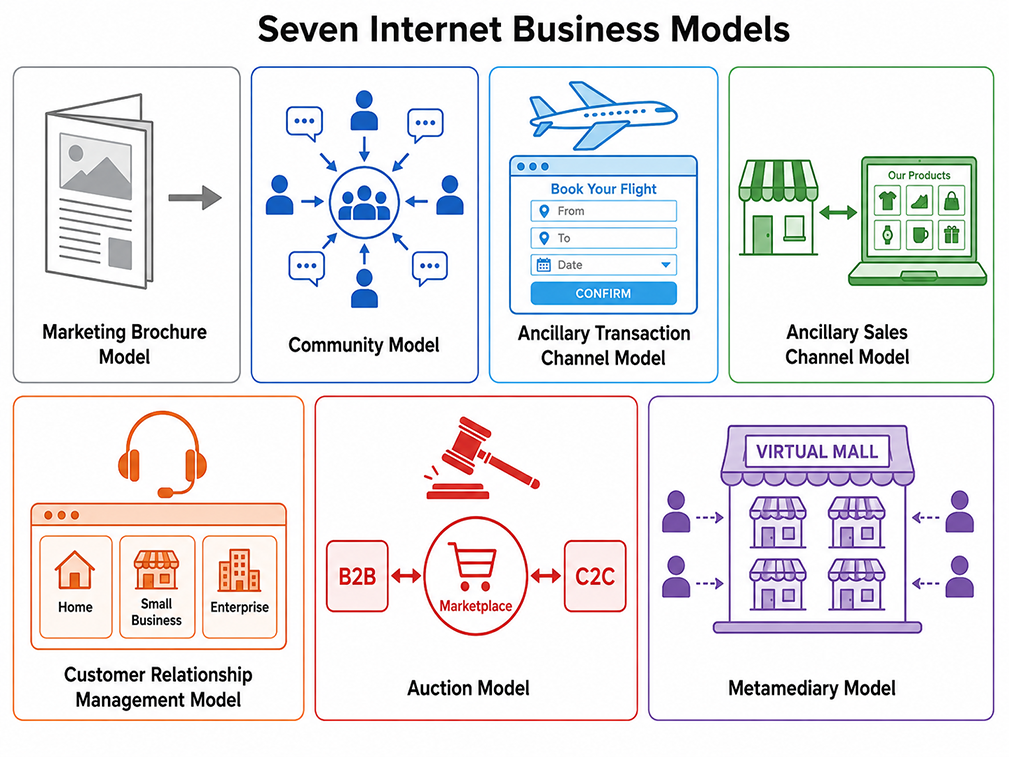
Internet Business Model Types
One of the first questions asked of any online startup is: what is your business model? The question matters because the model determines how revenue is generated, who the customer is, and what the website must do at a technical level to support the transaction. A subscription platform requires account management, recurring billing, and churn prevention features that a one-time retail transaction site does not need. A brokerage platform requires matching logic, fee calculation, and dispute resolution infrastructure that a direct manufacturer site does not require. Model selection is a business decision, but its consequences are entirely architectural — the developer who understands the model builds the right system the first time.
The good news for entrepreneurs and developers alike is that Internet business models are not invented from scratch for each new venture. They follow established patterns that have been documented and refined over decades of commercial web development. Professor Michael Rappa, formerly of North Carolina State University's Institute for Advanced Analytics, produced one of the most widely cited taxonomies of Internet business models. His framework identifies nine distinct models, each representing a different approach to generating value and revenue online. These models remain relevant in 2026 and continue to appear in both pure and hybrid form across the commercial web.
- Brokerage: Brokers function as market-makers, connecting buyers and sellers and facilitating transactions between them. The broker does not typically own the inventory or service being exchanged — the value the broker provides is the aggregation of supply and demand in one place. The broker charges a fee or commission for each transaction completed through the platform. Modern examples include Zillow in real estate, Uber in transportation, and StockX in authenticated resale markets. The broker model works because both buyers and sellers benefit from the aggregation — a buyer searching for a used car reaches more sellers through a broker platform than through direct search, and a seller reaches more qualified buyers than through any individual listing.
- Advertising: The web advertising model extends the traditional broadcast media approach — television, radio, print — to the online environment. A website provides content or services at no direct cost to the user, generating revenue by selling advertising space alongside that content to businesses that want to reach the site's audience. Google's Display Network and Meta's advertising platform are the dominant contemporary examples, together accounting for the majority of global digital advertising spend. The model depends on traffic volume and audience targeting precision — two factors that have made programmatic advertising the primary revenue source for much of the open web, from major news publishers to niche content sites.
- Infomediary: Infomediaries collect and organize information about products, producers, or consumers, and make that data useful to one or both sides of a transaction. A consumer researching a major purchase benefits from an infomediary that aggregates specifications, pricing, and reviews across multiple vendors. A business seeking to understand its market position benefits from an infomediary that tracks competitor pricing and consumer sentiment. NerdWallet in personal finance and Wirecutter in product recommendations are current examples of consumer-facing infomediaries. The infomediary earns revenue through referral fees paid by vendors when a consumer clicks through and completes a purchase, through lead generation fees, or through data licensing to institutional clients.
- Merchant: The merchant model covers wholesalers and retailers selling goods or services directly through a website, taking ownership of the inventory and fulfilling orders to the buyer. Pricing may be fixed at a listed price or variable through auction mechanisms. Amazon operating as a first-party retailer — buying inventory from suppliers and selling it directly to consumers — and traditional brick-and-mortar retailers operating their own ecommerce storefronts both follow the merchant model. The core operational requirements of this model are inventory management, payment processing, order fulfillment, and returns handling, each of which maps directly to systems the web developer must integrate or build.
- Manufacturer (Direct Model): The manufacturer model uses the web to allow a producer to sell directly to the end consumer, compressing or eliminating the traditional distribution channel that previously included wholesalers, distributors, and retailers. Each layer removed from the channel reduces cost and gives the manufacturer more control over the customer relationship and brand experience. Dell pioneered this approach in personal computing in the 1990s by building computers to order and shipping directly to buyers, bypassing retail entirely. Apple's direct sales through apple.com, Nike's direct-to-consumer digital channel, and Tesla's online-only sales model are prominent contemporary examples. The model gives manufacturers direct access to customer purchase data that the traditional channel obscured.
- Affiliate: The affiliate model distributes purchase opportunities across a network of partner sites rather than concentrating all traffic at a single destination. A content site, blog, or comparison tool that links to a product on a merchant site earns a percentage of the revenue when a referred visitor completes a purchase. Amazon Associates is the most widely used affiliate program on the web, with millions of publisher sites earning commissions by embedding product links in relevant content. For web developers, implementing affiliate tracking requires careful attention to link attribution parameters, cookie duration and handling, and compliance with FTC disclosure requirements that mandate clear identification of affiliate relationships to readers.
- Community: The community model builds commercial value on the foundation of user loyalty and participation rather than on owned inventory or direct transactions. Users invest time and social capital in the platform — contributing content, building reputation, and forming relationships — and that investment creates the retention that makes the community commercially valuable. Revenue may come from advertising displayed to the engaged audience, premium subscription tiers that offer enhanced features, ancillary product sales, or voluntary contributions from users who want to support the platform. Reddit, GitHub, and Stack Overflow each operate variants of the community model. The web developer's role in community platforms involves building the engagement features that sustain participation: notifications, reputation systems, user profiles, content moderation tools, and the social graph that connects members to each other.
- Subscription: Users pay a recurring fee — daily, monthly, or annual — to access a service, content library, or software platform. The subscription model has become the dominant revenue structure for software-as-a-service (SaaS) products, replacing the one-time license purchase model that previously characterized commercial software. Adobe Creative Cloud, Microsoft 365, Spotify, and Netflix all operate on subscription billing. The model is attractive to businesses because it converts unpredictable one-time revenue into predictable recurring revenue that can be forecasted and planned against. For web developers, subscription platforms require robust account management, payment gateway integration with support for recurring billing, dunning management for failed payments, and churn prevention features such as usage dashboards, pause options, and renewal reminders.
- Utility (On-Demand): The utility model charges users based on actual consumption rather than a fixed subscription fee. It is a pay-as-you-go approach where cost scales directly with usage — a customer who uses more pays more, and a customer who uses less pays less, with no minimum commitment required. Amazon Web Services, Google Cloud Platform, and Microsoft Azure all price compute, storage, and network bandwidth on a utility basis, billing by the hour, gigabyte, or request. This model has become foundational infrastructure for the modern web — most ecommerce sites rely on cloud utility services for hosting, content delivery, and data processing even when their own customer-facing revenue model follows a different pattern entirely.
Internet business models are rarely implemented in isolation. Most successful ecommerce sites combine elements from two or more models simultaneously, and the combination is often what creates the competitive advantage. A merchant site may incorporate an affiliate program that extends its reach through partner publishers, an advertising layer that monetizes traffic that does not convert to a purchase, and a subscription tier that gives loyal customers free shipping and early access to sales. Each layer of the model adds revenue potential but also adds architectural complexity — the developer who builds the system must understand all of the models in play to design the integrations correctly.
For web developers, model literacy is practical knowledge, not abstract theory. The business model determines which payment gateways must be integrated, which third-party APIs are required, what the database schema must track, and what the performance and scalability requirements are under peak load. A brokerage platform handling high-frequency auction bidding has fundamentally different real-time data requirements than a subscription SaaS platform serving a steady authenticated user base. A community platform whose value is entirely in user-generated content has fundamentally different content moderation and storage requirements than a manufacturer direct site whose value is in product inventory and order fulfillment. Identifying the model first makes every subsequent architectural decision more precise.
In the next lesson, you will learn about the characteristics of business-to-business sites.
Conducting Internet Business - Exercise
Click the Exercise link below to practice identifying types of Internet business models.
Conducting Internet Business - Exercise