| Lesson 4 | Business-to-consumer (B2C) sites |
| Objective | Define the characteristics of Business-to-Consumer (B2C) sites |
Business-to-Consumer (B2C) Sites
Business-to-consumer ecommerce is the sale of products and services from a business directly to individual consumers through a website or digital platform. It is the model most people encounter in daily life — purchasing clothing from a retailer's website, ordering groceries for home delivery, streaming a film from a subscription service, or downloading software from a vendor's storefront. B2C is the most visible face of ecommerce, and it has reshaped consumer expectations about convenience, selection, pricing transparency, and delivery speed in ways that have permanently altered the retail industry.
While B2B transactions are characterized by large order values, long sales cycles, structured procurement workflows, and known buyers operating within defined organizational roles, B2C transactions are fundamentally different in almost every dimension. The buyer is typically an individual acting independently, often anonymously, with no prior relationship with the seller. The purchase decision can be made in seconds based on a product image, a price comparison, and a customer review. The payment is immediate, using a credit card, digital wallet, or installment service. The expectation is that the order will be confirmed instantly and delivered within days or hours. The B2C website must be designed around all of these behavioral realities — not around the procurement workflows and approval chains that define B2B purchasing.
From the business perspective, the overarching goal of a B2C site is to create a more cost-effective way to serve customers than a physical retail operation can achieve. A physical store is constrained by geography, operating hours, floor space, and staffing costs. An ecommerce site has none of those constraints — it can serve customers in any location, at any hour, with a product catalog of essentially unlimited depth, operated by a fraction of the staff required to run an equivalent physical retail presence. The cost savings flow both to the business, in the form of lower operating costs per transaction, and to the consumer, in the form of lower prices and broader selection than any physical store can offer.
From the consumer's perspective, the benefits of B2C ecommerce are immediacy, selection, pricing transparency, and 24/7 availability. A consumer researching a purchase can compare specifications and prices across dozens of competing products in minutes, read hundreds of verified customer reviews, check current inventory and delivery estimates, and complete the purchase without leaving their home. Online retail sales globally exceeded $5.8 trillion in 2023 and continue to grow as mobile commerce, social commerce, and same-day delivery capabilities expand the convenience advantage that digital storefronts hold over physical retail.
For web developers, building a B2C ecommerce site requires mastery of the full transaction stack: product catalog management, search and filtering, product detail pages with dynamic inventory status, shopping cart and session management, checkout flow, payment gateway integration, order confirmation, and post-purchase communication. Each element of this stack has direct impact on conversion rate — the percentage of visitors who complete a purchase — which is the primary metric by which B2C ecommerce performance is measured.
The B2C Transaction Path
The B2C transaction path is the sequence of steps a consumer takes from first arriving on a site to completing a purchase. Understanding this path is essential for web developers because every friction point in the sequence reduces conversion rate, and the cumulative effect of small friction points across millions of sessions translates directly into lost revenue. The path consists of five stages: discovery, evaluation, cart, checkout, and confirmation.
Discovery is the entry point — how the consumer arrives at the site. This may be through organic search, a paid advertisement, a social media post, an email campaign, or a direct URL. The landing page the consumer reaches must immediately confirm relevance — that the site sells what they are looking for — and load fast enough that the consumer does not abandon before the page is fully rendered. Google's Core Web Vitals benchmarks, particularly Largest Contentful Paint (LCP), measure this initial load experience and use it as a search ranking signal, creating a direct connection between page performance and organic traffic volume.
Evaluation is the phase where the consumer examines product options, reads reviews, and compares prices. Product detail pages must present accurate specifications, high-quality images from multiple angles, current pricing, real-time inventory status, and customer reviews in a layout that is scannable on both desktop and mobile viewports. The majority of B2C ecommerce traffic now originates from mobile devices, which means that every product page must be designed and tested for a narrow mobile screen first, with desktop as a secondary consideration.
Cart and checkout are where most abandonment occurs. Industry data consistently shows that approximately 70% of shopping carts are abandoned before purchase is completed. The most common reasons are unexpected shipping costs revealed at checkout, a checkout process that requires account creation before purchase, too many form fields, and the absence of a preferred payment method. Reducing cart abandonment requires transparent shipping cost presentation early in the path, guest checkout as a default option, a streamlined single-page or minimal-step checkout form, and support for the payment methods the target audience uses most.
Confirmation closes the transaction and begins the post-purchase relationship. An order confirmation page and email provide the consumer with a record of the transaction and set expectations for fulfillment timing. Automated shipping notifications with tracking links reduce customer service contacts and reinforce trust in the merchant.
Payment
Consumer credit card transactions in B2C ecommerce are processed through merchant systems, which differ fundamentally from the EDI-based invoice automation used in B2B environments. In B2B, payment follows the delivery of goods by days or weeks under net-term agreements negotiated between known trading partners. In B2C, payment is authorized in real time at the moment of purchase, before the order is fulfilled, by a consumer whose identity the merchant may not know beyond the payment credentials they provide.
A merchant system consists of three core components that must all be in place for a retailer to accept card payments online. The merchant server handles the web-based transaction interface — the checkout form and the order management system behind it. The payment gateway is the software layer that communicates between the merchant's server and the card network, transmitting the authorization request and returning the approval or decline response in real time. The merchant account is a specialized bank account held at a financial institution that is authorized to receive card payment settlements — funds from approved transactions are deposited into the merchant account before being transferred to the retailer's operating account, typically within one to three business days.
Modern payment platforms have significantly simplified this architecture for retailers of all sizes. Stripe and PayPal abstract the merchant server and payment gateway into a single API integration that a developer can implement in hours. Both platforms handle the tokenization of card data — capturing the card number on their own secure servers rather than the merchant's, which substantially reduces the merchant's PCI compliance burden. Square, Shopify Payments, and similar integrated solutions go further, combining the payment gateway, merchant account, and ecommerce platform into a single subscription that requires no separate payment infrastructure setup at all.
Beyond traditional credit and debit cards, B2C sites now routinely support a range of alternative payment methods that have become consumer expectations rather than optional extras. Digital wallets including Apple Pay and Google Pay allow consumers to complete purchases using payment credentials stored on their device, authenticating with biometric verification rather than manually entering a card number. Buy Now Pay Later services — offered by Affirm, Klarna, Afterpay, and others — allow consumers to split purchases into installments, typically four equal payments over six weeks, with no interest charged to the consumer. The merchant receives full payment immediately from the BNPL provider, which assumes the credit risk of the installment plan. BNPL adoption has grown rapidly across apparel, electronics, home goods, and travel categories, and its absence from a checkout flow is now a measurable source of cart abandonment among younger consumer demographics.
Security
Consumer concern over the security of online transactions is a persistent factor in B2C ecommerce, and it is well founded. B2C sites transmit confidential personal and financial data with every purchase — credit card numbers, billing and shipping addresses, email addresses, and account passwords. This data is a high-value target for interception during transmission, theft from inadequately secured databases, and exploitation through phishing attacks that impersonate legitimate merchants. Securing this data is both a technical requirement and a legal obligation, and the visible security signals on the site are also a commercial requirement — a consumer who does not trust the site with their payment information will not complete the transaction.
The current standard for securing data in transit is TLS (Transport Layer Security) 1.3, which superseded the earlier SSL (Secure Sockets Layer) protocol that was the previous standard for ecommerce encryption.[1] TLS establishes an encrypted connection between the consumer's browser and the merchant's server, ensuring that all data transmitted during the checkout session — including the card number, expiration date, and CVV — is encrypted before leaving the consumer's device and can only be decrypted by the merchant's server using the corresponding private key. No intermediate party who intercepts the transmission can read the data. The padlock indicator displayed in a browser's address bar confirms to the consumer that the connection is TLS-protected.
PCI DSS — the Payment Card Industry Data Security Standard — is the compliance framework that governs how merchants handle cardholder data after it is received. Established by the major card networks (Visa, Mastercard, American Express, Discover, and JCB), PCI DSS defines technical and operational requirements covering network architecture, access controls, encryption of stored data, vulnerability scanning schedules, penetration testing, and incident response planning. Merchants are categorized into compliance levels based on annual transaction volume, with higher-volume merchants subject to more rigorous third-party audit requirements. Retailers that use hosted payment pages provided by Stripe, PayPal, or similar processors can operate at the lowest compliance level, because cardholder data is captured and processed entirely on the payment provider's PCI-certified infrastructure and never transmitted to or stored on the merchant's own servers.
Beyond the technical security layer, trust signals on the site itself directly influence consumer willingness to submit payment. A clearly posted privacy policy that explains what data is collected and how it is used, a visible and specific returns and refund policy, security badges from recognized certification authorities, and customer reviews that indicate an established transaction history all reduce the hesitation a first-time visitor feels before entering payment credentials on an unfamiliar site. For web developers, implementing these trust elements is as important to conversion rate as the technical security infrastructure that operates invisibly beneath them.
See the table below for an overview of the characteristics of a B2C site.
| Business-to-Consumer Sites | Characteristic |
|---|---|
| Goal | Create a more cost-effective way to serve customers through a digital storefront that operates continuously without physical retail overhead |
| Benefit | 1) Immediacy, 2) Selection, 3) Pricing transparency, 4) 24/7 availability |
| Payment | Credit card processing via merchant systems (server, gateway, merchant account); modern options include Stripe, PayPal, Apple Pay, Google Pay, and BNPL platforms (Affirm, Klarna, Afterpay) |
| Security | TLS 1.3 encryption for data in transit; PCI DSS compliance for cardholder data handling; trust signals including security badges and posted privacy policies |
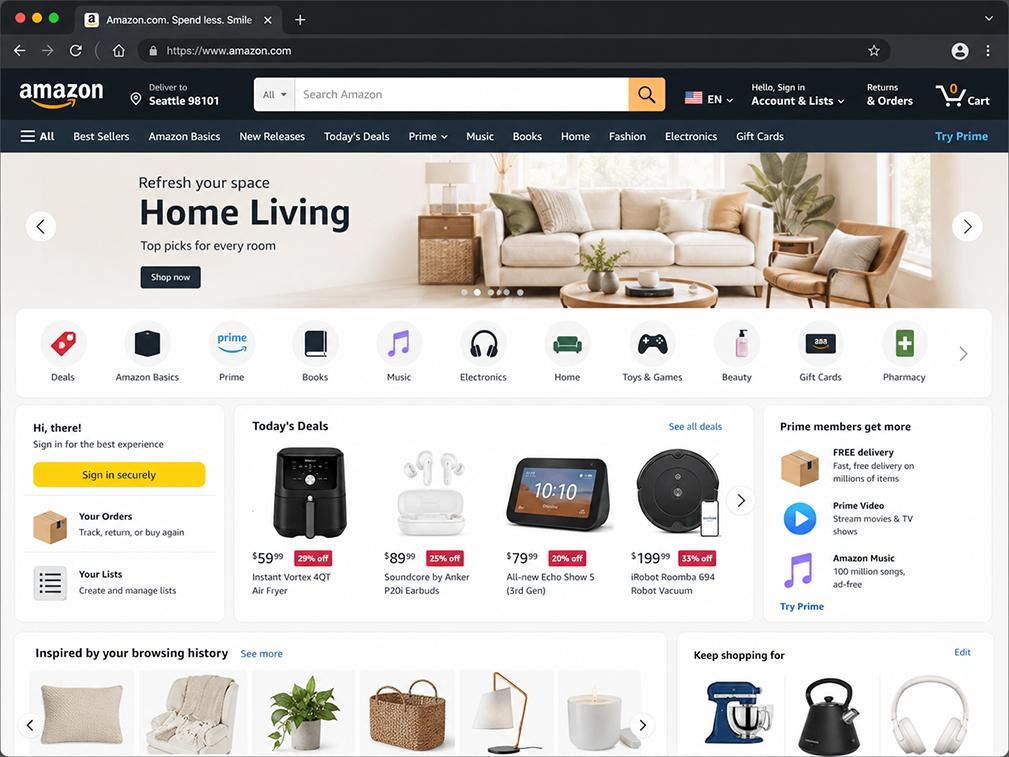
| Sample Site | Amazon.com — the largest B2C ecommerce platform, offering consumer retail across all product categories with integrated payment, fulfillment, and account management |
In the next lesson, you will learn about the characteristics of consumer-to-consumer sites.