| Lesson 2 | Web Interaction Model and SPAs |
| Objective | Review the evolution of web interaction from legacy layers to dynamic applications. |
Describing the Web Interaction Model
In the domain of web design, the Web Interaction Model (WIM) delineates the communication process between a user and a web-based application. While the traditional model was built on a sequential "Request-Response" loop, modern web standards have shifted toward the Single Page Application (SPA) paradigm. This lesson explores both the foundational layers and the modern replacements that define today's digital experiences.
Primary Elements of Interaction
To understand how a user experiences a website, we must break down the interaction into six core elements:
- The User: The individual interacting with the interface. In 2026, we must account for their context (mobile, desktop, or assistive technology).
- The User Agent (Browser): No longer just a viewer, modern browsers like Chrome or Firefox act as execution environments for complex JavaScript.
- The Web Application: This has evolved from static server-side files to dynamic "Headless" systems that serve data via APIs.
- HTTP/HTTPS Protocol: The bedrock of data exchange. Modern sites prioritize HTTP/3 for faster, multiplexed data streams.
- The Interface (State): In an SPA, the "webpage" is a living state. Components update individually without a full browser refresh.
- User Inputs: Beyond clicks, we now plan for touch gestures, voice commands, and spatial interactions.
The Traditional Five-Layer Model
The legacy Web Interaction Model is often visualized as a series of five dynamic layers. While the technology within them has changed, the structural relationship remains a vital planning tool.
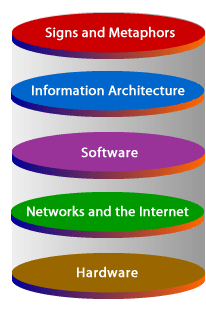
1. Signs and Metaphors (User Experience)
The top layer focuses on the semiotics of the site—using icons and metaphors (like a "shopping cart" or "home" icon) to guide the user. In SPAs, this layer must be highly responsive, providing instant visual feedback for every user action.
2. Information Architecture (IA)
The structural design of the information. While traditional models used deep hierarchies, modern SPAs often use Flat Architectures where data is fetched dynamically based on user intent.
3. Software and Logic
This is the "glue" that binds content and presentation.
- Legacy Logic: Server-side scripts (PHP/ASP) that generated HTML before sending it to the user.
- Modern Logic: Client-side frameworks (React, Vue, Svelte) that manage "State" in the browser for instant transitions.
4. Networks and Connectivity
Legacy systems relied on expensive T1/T3 lines. Today, we plan for Edge Computing and CDNs (Content Delivery Networks), which place the website data geographically closer to the user to minimize latency.
5. Hardware and Infrastructure
We have moved from physical server rooms to Serverless Cloud Infrastructure (AWS, Azure, Vercel). Planning now focuses on scalability and uptime rather than physical maintenance.
The Modern Integration: Content, Presentation, and Logic
A website is an integration of three components, each undergoing a radical transformation in the 2020s:
Content
Consists of all data shown to the user. Modern Shift: Content is now typically "Headless," stored in a CMS and delivered as JSON data rather than static HTML files.
Presentation
The user interface. Modern Shift: We use Component-Based Design Systems (Atomic Design) and Utility-First CSS (like Tailwind) to ensure visual consistency across different device types.
Logic
Determines what to display and processes user inputs. Modern Shift: In an SPA model, the logic is responsible for Client-Side Routing, ensuring that the URL changes even though the page hasn't reloaded.
Limitations and Strategic Planning
You should keep in mind that there is significant overlap between these layers. One layer's failure (e.g., a slow network) directly impacts the user's perception of the top layer (Signs and Metaphors).
The SPA Trap: While SPAs offer a superior user experience, they can be over-engineered for simple sites. When planning, do not fall into the trap of choosing an SPA for a static blog where a traditional MPA would offer better SEO and faster initial load times.
Collaboration: Careful planning for a website is priceless. Consult all team members—from the UX designers focused on metaphors to the DevOps engineers managing the hardware—to ensure end-user satisfaction.
The next lesson provides a review of the Web Development Process Model, where we take these interaction concepts and put them into a project timeline.