| Lesson 4 | Approval process |
| Objective | Describe the approval process which team members will work towards when having contracts approved and signed. |
The Approval Process: Strategies for Streamlining the Definition Phase
Every web development project moves through a series of phases — Discovery, Definition, Design, Development, Delivery, and Post-Delivery. Of these, the Definition phase is where the commercial and creative foundation of the project is established. Contracts are drafted, briefs are reviewed, and stakeholders commit to a shared direction before any design or development resources are spent. Without a structured approval process during this phase, the project has no enforceable baseline — and without a baseline, every subsequent deliverable is subject to renegotiation.
The approval process is not administrative overhead. It is a risk management instrument. A client who has formally approved the Creative Brief cannot reasonably demand that the interface metaphors be redesigned from scratch after the development team has built three modules around them. Approval creates accountability on both sides of the client relationship and protects the web team from scope creep driven by stakeholder indecision.
The Six Phases of Web Development
The web development process divides into six phases that move the project from initial discovery to ongoing maintenance. The first two — Discovery and Definition — establish what the website needs to accomplish and how it will accomplish it. Discovery surfaces the business objectives, target audiences, and success criteria. Definition translates those findings into actionable briefs, contracts, and project plans that all parties agree to before creative work begins.
Design and Development follow Definition, producing the visual language, interface elements, and functional components of the site. Delivery transitions the completed site to the client and verifies that the delivered product meets the agreed-upon specifications. Post-Delivery encompasses monitoring, iteration, and ongoing editorial maintenance — activities that are only possible if the Definition phase produced clear, documented standards to measure against.
This lesson addresses a specific aspect of the Definition phase: the process by which business role team members obtain approval of contracts, briefs, and creative deliverables from internal and external clients. Getting this process right early in the project establishes a pattern of disciplined communication that carries forward through every subsequent phase.
Why the Approval Process Is a Success Factor
The creation of signs and metaphors — the visual vocabulary of a website — is iterative. Early versions are rough; they improve through successive rounds of feedback and refinement. The problem is not iteration itself but unapproved iteration. When a design team refines interface elements through multiple cycles without obtaining client sign-off at each stage, they are building on an unvalidated foundation. A senior stakeholder who was not consulted during early iterations can invalidate weeks of work with a single review comment.
The goal of a structured approval process is to make stakeholder input predictable and timely. Each phase of the creative process produces a specific deliverable — a brief, a sketch, a clickable prototype — and each deliverable requires a discrete approval before the next phase begins. This staged approach limits the blast radius of any single feedback cycle: changes requested at the sketch stage cost hours to implement; the same changes requested after a fully developed prototype has been built cost days or weeks.
If you design and develop without an approval process, you risk two outcomes. The client rejects the completed work and requests revisions that require significant rework. Or the client accepts work they are not fully satisfied with, producing a post-launch relationship characterized by ongoing friction rather than confidence. Both outcomes are avoidable with a disciplined approval process established during the Definition phase.
The Five-Step Approval Process
The following approval process describes the formal stages through which creative deliverables move from initial concept to client-approved production asset. Each step produces a specific output that requires client review and sign-off before the next step begins. Additional iterative cycles may occur within each step, but the formal approval gates define the minimum required checkpoints.
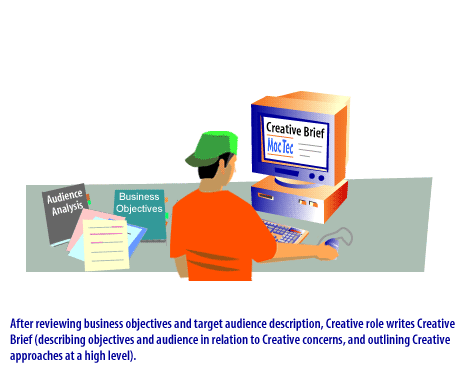
Step 1: Audience Analysis and Business Objectives
After reviewing business objectives and target audience descriptions, the creative role produces the Creative Brief. The brief describes the relationship between audience characteristics and creative concerns, and outlines the proposed creative approach at a high level. Client approval of the Creative Brief authorizes the design team to proceed to interface element development.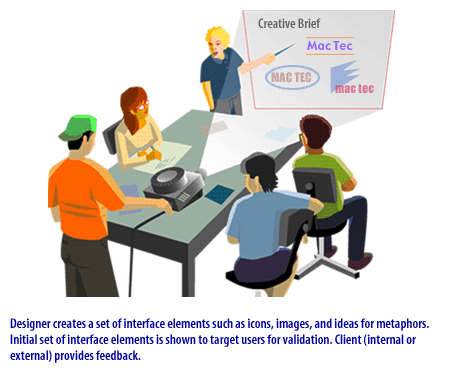
Step 2: Interface Element Development and User Validation
The designer creates an initial set of interface elements — icons, imagery, and candidate metaphors that express the site's visual language. This initial set is presented to representative target users for validation before the client sees it, ensuring that the metaphors resonate with the intended audience. The client then reviews the validated set and provides feedback, which may generate an additional iteration cycle before approval is granted.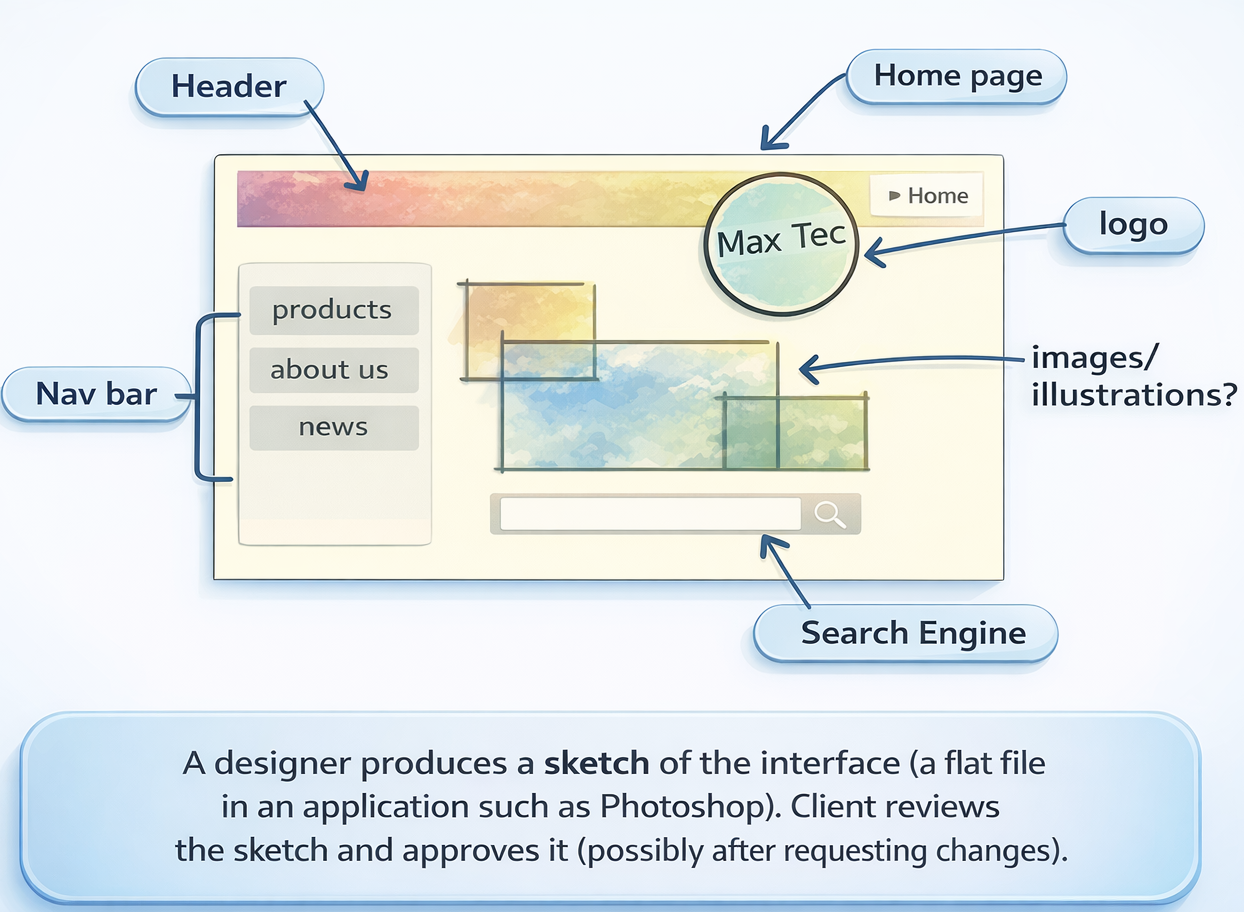
Step 3: Interface Sketch and Client Review
Using the approved interface elements, the designer produces a sketch of the interface — a static flat file created in a design application such as Photoshop, Figma, or Sketch. The sketch shows the proposed layout, visual hierarchy, and application of the approved metaphors to actual page structures. The client reviews the sketch and either approves it or requests specific changes. In modern workflows, this stage may produce multiple sketch variants for A/B evaluation before a single direction is approved.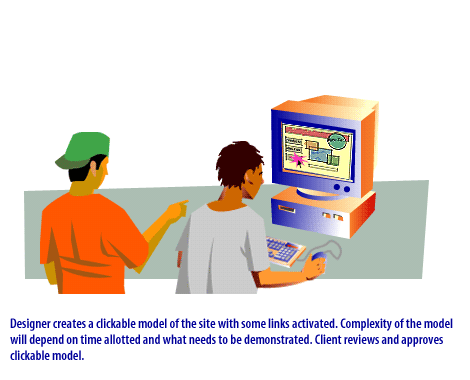
Step 4: Clickable Prototype and Interaction Review
The approved sketch is evolved into a clickable prototype — an interactive model of the site with representative navigation paths and key interactions activated. The prototype's complexity depends on the time available and the specific decisions that need to be validated. Its purpose is to give the client a realistic experience of how the site will behave before any production code is written. Client approval of the prototype authorizes the team to proceed to full creative development. In contemporary practice, tools such as InVision, Figma Prototype, or Adobe XD are used to produce high-fidelity interactive prototypes that closely approximate the final user experience.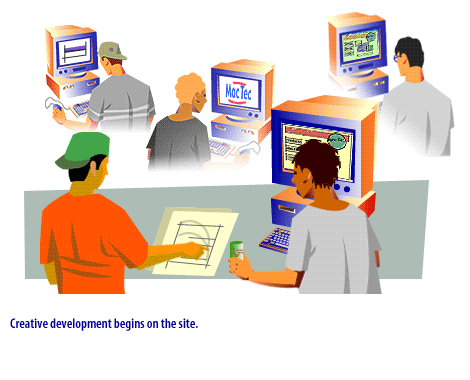
Step 5: Creative Development Begins
With all prior approvals in place — Creative Brief, interface elements, interface sketch, and clickable prototype — full creative development of the site begins. At this stage the web team has a validated visual language, an approved layout direction, and a confirmed interaction model. Development proceeds against a documented, client-approved specification, eliminating the ambiguity that drives costly mid-development revisions.Applying the Approval Process to Editorial Content
The same approval discipline that governs creative deliverables applies equally to editorial content. The Editorial Brief and content outline should be reviewed and approved by the client before any full content development begins. Writing full page content against an unapproved editorial direction carries the same risk as designing a full interface against an unapproved Creative Brief — the client may reject the tone, structure, or scope of the content after significant writing resources have been spent.
For both the Creative and Editorial Briefs, two general rules facilitate the approval process:
- Educate your client about the phases of the process. Clients who understand that each phase produces a specific deliverable requiring their review are more likely to respond in a timely manner. Many clients — particularly those who have not worked with a web development team before — assume that the process proceeds linearly from brief to launch with minimal input required from them. Making the approval gates explicit at the outset sets accurate expectations and reduces delays caused by client unavailability.
- Suggest specific return dates when seeking approval. A client who is new to the process may not understand that the web team cannot proceed until approval is granted. Communicating the timeline impact of delayed approval — and requesting a specific response date — gives the client a concrete action to take rather than an open-ended review obligation. The proposal language that formalizes this principle: "Timely return of this letter is requested, and non-response within the defined period of time will imply acceptance."
The Approval Process in Modern Web Development
Contemporary web development methodologies have evolved the approval process without eliminating its fundamental discipline. In Agile environments, sprint reviews perform a structured approval function — the product owner accepts or rejects completed work at the end of each sprint, creating a regular cadence of client validation that mirrors the staged approval gates of the traditional process. The difference is frequency: where the traditional process has five formal gates, an Agile sprint review occurs every one to four weeks throughout the project lifecycle.
Design systems have changed the nature of the interface element approval step. Rather than approving a bespoke set of icons and metaphors for a single project, clients now approve a component library — a reusable set of design tokens, components, and patterns that maintains visual consistency across the site and across future projects. Approval of the design system replaces approval of individual interface elements and produces a more durable creative asset.
Digital prototyping tools have compressed the time between sketch approval and clickable prototype. Figma, Adobe XD, and similar tools allow designers to produce high-fidelity interactive prototypes directly from approved design components, reducing the time between Step 3 and Step 4 from days to hours in many cases. The approval gates remain; the time required to move through them has decreased significantly.
Contract management platforms — DocuSign, Adobe Sign, PandaDoc — have modernized the mechanics of obtaining formal client signatures. Digital signatures are legally binding in most jurisdictions and eliminate the delays associated with printing, signing, scanning, and returning physical documents. The approval process discipline remains unchanged; the friction of executing approvals has been substantially reduced.
What Happens Without an Approval Process
Question: What problems might arise if someone on your team does not facilitate good turnaround time on contract approval?
Answer: The web team sits idle waiting for authorization to proceed — burning billable time against a fixed project budget. Alternatively, the team begins work based on unvalidated assumptions, producing deliverables that may require extensive revision when the client finally reviews them. Both outcomes increase project cost and compress the timeline available for subsequent phases. A team that has learned to manage the approval process proactively avoids both failure modes by making client response a scheduled project activity rather than an unpredictable dependency.