| Lesson 3 | How Networks Communicate |
| Objective | Illustrate TCP, IP, HTTP, and FTP Protocols |
How Networks Communicate: Illustrating TCP, IP, HTTP, and FTP Protocols
In the modern era, network communication is the invisible nervous system of our global civilization. From the simple exchange of a text message to the complex, multi-modal streaming of Artificial Intelligence (AI) data, the ability for computers to "talk" is governed by a strict hierarchy of rules known as protocols. This lesson explores the foundational pillars of the Internet: TCP, IP, HTTP, and FTP, and how they have evolved to support an AI-experience-first world.
1. The Foundation: The Web Interaction Model
To understand protocols, we must first understand the Web Interaction Model. Traditionally, this was a simple Client-Server relationship: a user (the client) requests a file, and a remote computer (the server) provides it. However, in 2026, this has shifted toward a Distributed Experience Model. Data is no longer just "delivered"; it is orchestrated across edge networks, CDNs (Content Delivery Networks), and localized AI inference nodes to ensure that the user experience is instantaneous and contextually aware.
The network transmits data through a variety of physical and virtual mediums. While legacy systems relied on copper phone lines and dial-up modems, contemporary data travels via high-speed fiber optics, satellite constellations (like Starlink), and advanced wireless standards such as 5G and Wi-Fi 7. Regardless of the medium, the entry point remains the Network Interface—whether a physical chip in a laptop or a virtualized adapter in a cloud-based server container.
2. The Architecture of Communication: TCP/IP
The "Language of the Internet" is actually a suite of protocols, often referred to as the TCP/IP Stack. If the Internet were a postal service, IP would be the address on the envelope, and TCP would be the certified mail receipt that ensures the letter actually arrived.
IP (Internet Protocol): The Global Address System
IP is responsible for routing. It gives every device on a network a unique identifier.
// Example of an IPv4 Address
192.168.1.1

// Example of a modern IPv6 Address
2001:0db8:85a3:0000:0000:8a2e:0370:7334
IP is "connectionless." It doesn't care if the destination is ready to receive data; it simply wraps the data into "packets" and sends them into the digital wild, relying on routers to find the best path. In the AI-driven landscape, IP routing is now often optimized by machine learning algorithms that predict network congestion before it happens, rerouting traffic in milliseconds.
TCP (Transmission Control Protocol): The Reliable Handshake
While IP handles the "where," TCP handles the "how well." TCP is a connection-oriented protocol. Before data is sent, TCP establishes a "Three-Way Handshake":
- SYN: The client asks, "Can we talk?"
- SYN-ACK: The server responds, "Yes, I am ready."
- ACK: The client says, "Great, sending data now."
3. The Application Layer: HTTP and FTP
While TCP/IP works in the background (the transport and network layers), protocols like HTTP and FTP operate at the Application Layer—the part the user and the software interact with directly.
| Protocol | Modern Function | Benefits and Evolution |
|---|---|---|
| HTTP/HTTPS (Hypertext Transfer Protocol) | The backbone of Web and API interaction. It fetches HTML, JSON, and media. | HTTP/3: Now uses QUIC (over UDP) to eliminate "head-of-line blocking," making AI streaming and web apps incredibly fast. |
| FTP/SFTP (File Transfer Protocol) | Used for bulk file transfers between systems. | SFTP: The secure version is the standard today. It is slower than HTTP but offers robust directory management and file integrity checks. |
The Evolution of HTTP: From Static Pages to AI Streaming
In the original web model, HTTP was "stateless" and "request-response." You clicked, you waited, you received. Today, HTTP/3 is designed for the AI Experience-First era. When you interact with a Large Language Model (LLM), you don't wait for the whole 2000-word response to generate. Instead, HTTP supports "Server-Sent Events" (SSE) or WebSockets, allowing the AI to "stream" tokens to your screen in real-time, mimicking human thought patterns.
4. Understanding the URL: The Human Interface
Because humans struggle to remember IP addresses, we use the Domain Name System (DNS) to map names (like seotrance.com) to numbers. The Uniform Resource Locator (URL) is the specific path to a resource.
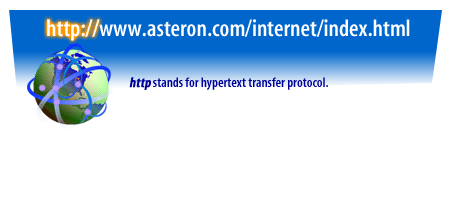
http:// or https:// tells the browser which set of rules to use to fetch the data.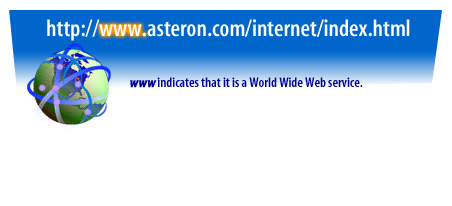
www is a legacy indicator for web services, though modern apps often use api or app.
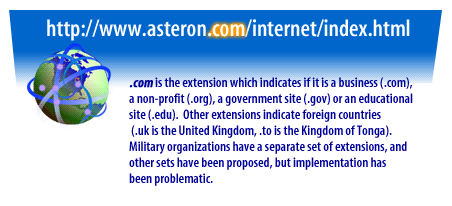
.com, .org, or modern ones like .ai or .io, providing context on the site's purpose.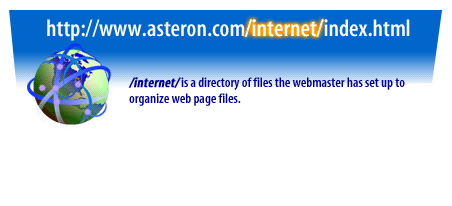
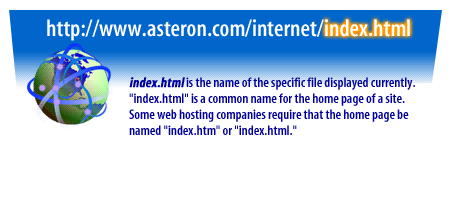
index.html or get-user-data).5. DNS and the Journey of a Packet
When you type a URL into your browser, a complex sequence occurs in milliseconds:
- DNS Resolution: Your computer asks a DNS server, "What is the IP for seotrance.com?"
- TCP Connection: Your device establishes a connection with that IP using the three-way handshake.
- TLS Handshake: (For HTTPS) A secure, encrypted tunnel is created to protect data from "man-in-the-middle" attacks.
- HTTP Request: Your browser sends a
GETrequest for the specific file. - Data Transfer: The server breaks the file into TCP packets, IP routes them through various switches and routers across the globe, and your device reassembles them.
In the AI experience-first approach, this journey is further optimized. AI "Edge" servers sit closer to the user, meaning the DNS resolution and the packet journey are shortened to reduce "Latency"—the delay that can make an AI assistant feel slow or "robotic."
Summary
Communication across a network is a collaborative effort. IP finds the house, TCP ensures the packages are all delivered and in the right order, HTTP is the conversation occurring at the door, and FTP is the heavy-duty moving truck for large shipments. Understanding these protocols is the first step in mastering the web-interaction models of the future.