| Lesson 5 | Hardware |
| Objective | Describe the Components of the Hardware Layer within the Web Interaction Model. |
Hardware Layer in the Web Interaction Model (2026)
The Hardware Layer represents the physical and infrastructure foundation that enables digital interaction. Within the Web Interaction Model, hardware supports every upper layer—software, information architecture, interaction design, and signs/metaphors—by providing computational power, connectivity, storage, and secure routing.
In 2026, hardware is no longer limited to physical servers in a single building. It includes hybrid cloud environments, edge devices, secure gateways, high-speed fiber connectivity, AI accelerators, and distributed compute clusters. The hardware layer is best understood as the execution substrate for intelligent digital interaction.
Hardware vs. Network in the Modern Model
In earlier conceptualizations, hardware and networks were discussed together. Today, we separate them for clarity:
- Hardware – Physical devices: servers, routers, switches, firewalls, cables, edge nodes, client devices.
- Network Architecture – Logical configuration: addressing, routing protocols, zero-trust policies, encryption frameworks.
- The network is the traffic system and policy rules.
- The hardware is the physical roads, bridges, traffic signals, and vehicles.
Core Hardware Components in 2026
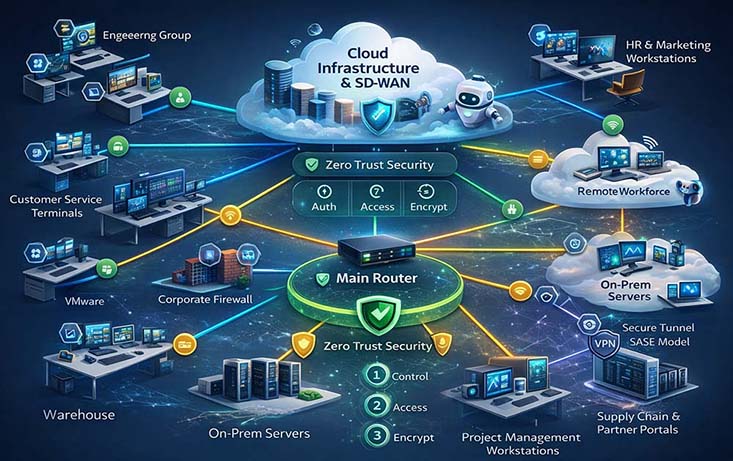
1. Client Devices
Clients are no longer limited to desktop PCs. They include:
- Laptops and mobile devices
- Tablets and thin clients
- IoT devices
- Edge sensors
- AI-enabled assistants
2. Edge Devices and Access Layer
Modern access infrastructure includes:
- Wi-Fi 6/6E/7 access points
- Fiber optic connectivity
- 5G/Private 5G gateways
- SD-WAN appliances
3. Routers and Layer 3 Devices
Routers connect multiple IP networks and direct packets based on routing tables and dynamic protocols such as BGP and OSPF. In modern architectures, routing integrates:
- IPv6 support
- Traffic prioritization (QoS)
- AI-driven anomaly detection
- Encrypted tunnels (IPsec, TLS)
4. Switches (Replacing Hubs)
Traditional hubs broadcast traffic to all devices and are obsolete in modern enterprise design.
Modern Layer 2/3 switches:
- Forward frames intelligently using MAC tables
- Segment traffic with VLANs
- Support Power over Ethernet (PoE)
- Enable network monitoring and telemetry
5. Firewalls and Secure Gateways
Firewalls protect the network perimeter and internal segments. In 2026, hardware firewalls integrate:
- Deep packet inspection
- Zero Trust enforcement
- Intrusion detection/prevention systems (IDS/IPS)
- AI-assisted threat modeling
6. Servers and Compute Infrastructure
Servers execute applications, host databases, and serve web content. Modern server environments include:
- On-premise rack-mounted servers
- Virtualized environments (VMware, KVM, Hyper-V)
- Container orchestration (Kubernetes clusters)
- Cloud-based instances (IaaS, PaaS)
- GPU and AI accelerators
7. Storage Systems
Web systems depend on resilient storage infrastructure:
- NVMe solid-state arrays
- Object storage systems
- Distributed storage clusters
- Cloud-based storage (S3-compatible)
8. Connectivity and Bandwidth
Bandwidth remains a defining hardware constraint. Modern connectivity includes:
- Fiber backbone connections
- Multi-gigabit Ethernet
- Redundant ISP connections
- Load-balanced SD-WAN
Hardware in the AI Experience-First Architecture
The AI experience-first approach changes how we evaluate hardware. The goal is no longer simply connectivity; it is intelligent responsiveness.
Hardware now supports:
- Real-time personalization engines
- Large language model inference
- Telemetry pipelines
- Behavior analytics systems
- Automated scaling
- High-throughput networking
- Low-latency storage
- Specialized AI accelerators
- Secure identity-aware routing
Updated Web Interaction Model Context
Within the Web Interaction Model:
- Signs and Metaphors – Rendered by client hardware.
- Information Architecture – Stored and served via database and server hardware.
- Software – Executed on compute hardware.
- Network Layer – Enabled by routers, switches, and connectivity hardware.
- Hardware Layer – The physical execution platform enabling all layers.
Elements of the Modern Interaction Stack
- Client Devices: Initiate encrypted web requests.
- Edge Gateways: Manage traffic and apply security policy.
- Application Servers: Process logic and return responses.
- Databases: Store structured and unstructured data.
- AI Services: Generate dynamic content and insights.
- Telemetry Systems: Monitor and optimize performance.
In the next lesson, we will observe how all five layers of the Web Interaction Model function together during a real-time transaction, illustrating how hardware, networks, software, and interface design converge in a single user interaction.