| Lesson 8 | Databases |
| Objective | Describe how the Application Layer communicates with the Database |
How the Application Layer Communicates with the Database
The application layer is the part of a software system that processes requests, applies business rules, validates user input, and coordinates access to stored data. In modern web applications, this layer usually sits between the user-facing interface and the database. When a user signs in, searches for a product, updates a profile, submits a form, or places an order, the application layer is responsible for deciding what data is needed, how it should be validated, and what changes must be written back to the database.
A database is not simply a place to store software files. More accurately, a database is a structured system for storing, organizing, retrieving, updating, and securing data. That data may include users, products, permissions, transactions, documents, audit records, inventory, analytics events, and application settings. The database provides durable storage, while the application layer provides the logic that determines how the data is used.
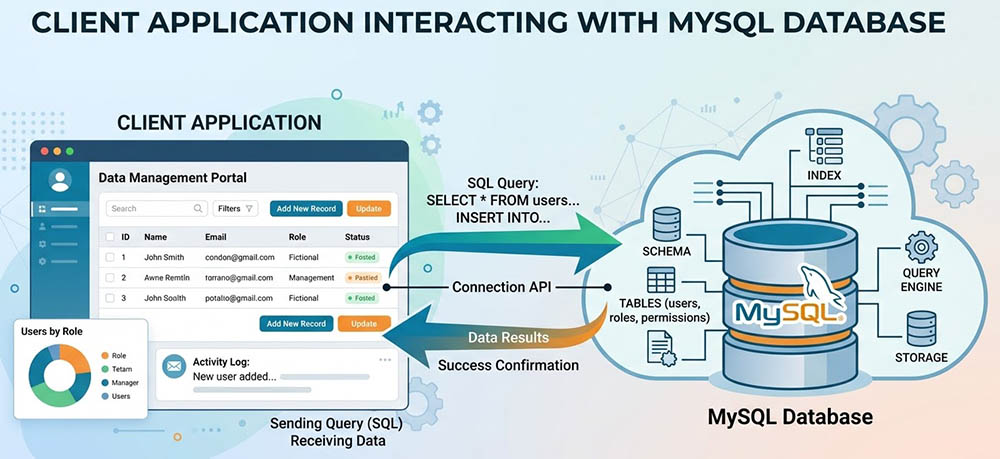
This relationship is essential to modern digital systems. The browser or front end collects user actions. The application layer interprets those actions. The database stores and returns the information needed to complete the task. In that sense, the application layer and the database are not competing components; they are coordinated parts of the same workflow.
A database is not simply a place to store software files. More accurately, a database is a structured system for storing, organizing, retrieving, updating, and securing data. That data may include users, products, permissions, transactions, documents, audit records, inventory, analytics events, and application settings. The database provides durable storage, while the application layer provides the logic that determines how the data is used.
This relationship is essential to modern digital systems. The browser or front end collects user actions. The application layer interprets those actions. The database stores and returns the information needed to complete the task. In that sense, the application layer and the database are not competing components; they are coordinated parts of the same workflow.
Why Databases Matter in Web Applications
Databases are foundational to most non-trivial web applications because modern sites need more than static pages. They need to remember information, support user-specific behavior, and preserve records over time.
For example, a database may store:
For example, a database may store:
- user account information such as names, email addresses, roles, and hashed credentials
- product catalogs, pricing, stock levels, and category relationships
- shopping cart contents and checkout transactions
- customer preferences and saved settings
- shipping, billing, and fulfillment data
- audit logs and activity history
- search indexes or metadata used to improve retrieval
- analytics or event data used to measure behavior and performance
The Basic Communication Flow
In a typical web interaction, the communication flow looks like this:
- The user performs an action in the interface, such as searching, logging in, or submitting a form.
- The client sends a request to the application layer, often over HTTP or HTTPS.
- The application layer validates the request and applies business logic.
- The application uses a database driver, connector, framework, or query interface to communicate with the database.
- The database processes the query or transaction and returns results, status information, or an error.
- The application layer transforms that outcome into a response the client can use.
- The interface displays the data, confirmation message, or error state to the user.
What the Application Layer Actually Does
The application layer is much more than a pass-through between the front end and the database. It is responsible for interpreting intent and coordinating system behavior.
Typical responsibilities include:
Typical responsibilities include:
- input validation and sanitization
- authentication and authorization checks
- query construction and parameter binding
- transaction management
- error handling and logging
- caching or performance optimization
- mapping database results into user-facing structures
- enforcing business rules such as inventory limits, pricing rules, or permission boundaries
ODBC and JDBC in Context
Two important historical and still-relevant database access technologies are ODBC and JDBC.
ODBC stands for Open Database Connectivity. It is a standard API used by applications, especially in C/C++ and many enterprise integration environments, to connect to relational databases through drivers. ODBC helps separate the application from the specific database vendor implementation by using a standard interface for database access.
JDBC stands for Java Database Connectivity. It is Java’s standard API for connecting Java applications to relational databases. JDBC allows Java code to open connections, execute SQL statements, use prepared statements, process result sets, and manage transactions.
In modern terms, both ODBC and JDBC belong to the connectivity layer between the application and the database. They do not replace the application layer. They support it by providing the mechanisms through which queries and results flow. In enterprise systems, they are still very relevant, especially where Java applications, reporting systems, middleware, ETL tools, analytics platforms, or vendor-neutral integrations need stable relational database access.
ODBC stands for Open Database Connectivity. It is a standard API used by applications, especially in C/C++ and many enterprise integration environments, to connect to relational databases through drivers. ODBC helps separate the application from the specific database vendor implementation by using a standard interface for database access.
JDBC stands for Java Database Connectivity. It is Java’s standard API for connecting Java applications to relational databases. JDBC allows Java code to open connections, execute SQL statements, use prepared statements, process result sets, and manage transactions.
In modern terms, both ODBC and JDBC belong to the connectivity layer between the application and the database. They do not replace the application layer. They support it by providing the mechanisms through which queries and results flow. In enterprise systems, they are still very relevant, especially where Java applications, reporting systems, middleware, ETL tools, analytics platforms, or vendor-neutral integrations need stable relational database access.
Communication Protocols Used with Databases
It is useful to distinguish between web protocols and database communication protocols.
On the web side, a browser usually communicates with the application over HTTP or HTTPS. These protocols handle client requests and server responses across the web.
Between the application layer and the database, communication usually happens through a database-specific wire protocol implemented by a driver or connector. The application may call a JDBC driver, ODBC driver, native client library, ORM, or framework abstraction, and that component then communicates with the database server using the protocol expected by that database engine.
So in a modern web request, several layers may participate:
On the web side, a browser usually communicates with the application over HTTP or HTTPS. These protocols handle client requests and server responses across the web.
Between the application layer and the database, communication usually happens through a database-specific wire protocol implemented by a driver or connector. The application may call a JDBC driver, ODBC driver, native client library, ORM, or framework abstraction, and that component then communicates with the database server using the protocol expected by that database engine.
So in a modern web request, several layers may participate:
- the browser speaks HTTP or HTTPS to the application server
- the application server uses a driver, connector, or ORM to prepare a database operation
- the database protocol carries the query, parameters, and returned results between the application runtime and the database engine
Connection APIs, Drivers, and Pools
Legacy material often refers vaguely to a “connection API.” In current architecture, that idea can be explained more precisely.
Applications communicate with databases through one or more of the following:
Applications communicate with databases through one or more of the following:
- drivers that implement the low-level database connectivity interface
- connection libraries that simplify authentication and session handling
- connection pools that reuse database connections efficiently instead of opening a new one for every request
- ORMs or query builders that help translate application objects or methods into SQL operations
- data access layers that isolate database logic from the rest of the application code
SQL Operations and Returned Results
When the application layer communicates with a relational database, the exchange often involves SQL operations such as:
The returned result may be a set of rows, a status code, a generated identifier, or a confirmation that a transaction succeeded or failed. The application layer then interprets that result and turns it into something meaningful for the client, such as a populated table, a JSON response, a success message, or a validation error.
SELECTto retrieve dataINSERTto add new rowsUPDATEto modify existing rowsDELETEto remove rows
The returned result may be a set of rows, a status code, a generated identifier, or a confirmation that a transaction succeeded or failed. The application layer then interprets that result and turns it into something meaningful for the client, such as a populated table, a JSON response, a success message, or a validation error.
Security and Integrity in Database Communication
Because the database often stores sensitive and business-critical information, database communication must be designed carefully.
Important concerns include:
Important concerns include:
- least-privilege access for application accounts
- parameterized queries and prepared statements
- proper transaction boundaries
- encryption in transit where supported and required
- hashing and secure handling of credentials
- auditing and logging of privileged operations
- input validation before data reaches the database layer
Oracle SQL Developer and Modern Database Communication
Oracle SQL Developer is a useful modern example of a tool that helps developers and administrators communicate with a database. It can be used to open connections, browse schema objects, run SQL statements and scripts, inspect data, debug PL/SQL, and manage database development tasks.
Tools like Oracle SQL Developer are not the application layer themselves, but they help developers design, test, and troubleshoot the same kinds of database interactions that production applications perform. In a development workflow, a programmer might verify a query in SQL Developer, then implement that logic in Java through JDBC, in PHP through a database extension, or in another backend stack through a supported driver.
Tools like Oracle SQL Developer are not the application layer themselves, but they help developers design, test, and troubleshoot the same kinds of database interactions that production applications perform. In a development workflow, a programmer might verify a query in SQL Developer, then implement that logic in Java through JDBC, in PHP through a database extension, or in another backend stack through a supported driver.
Where Databases Fit in the Broader Web Model
In the broader site architecture, the database is best understood as part of the data and persistence layer rather than as a separate “Web Interaction Model” layer with its own standalone conceptual model. The application layer communicates with the database to retrieve and update the structured information needed by the site.
This is a clearer and more technically accurate framing than treating the database as a vague background support mechanism. In a modern stack, the application layer, API layer, and data layer are distinct but cooperating components. The application layer processes intent. The database provides durable, queryable storage. Together they support search, personalization, transactions, reporting, and content delivery.
This is a clearer and more technically accurate framing than treating the database as a vague background support mechanism. In a modern stack, the application layer, API layer, and data layer are distinct but cooperating components. The application layer processes intent. The database provides durable, queryable storage. Together they support search, personalization, transactions, reporting, and content delivery.
Question and Answer
Question: List five functions that databases might serve in an e-commerce site.
Answer: You may have listed some of the following functions:
- storing customer account information and preferences
- retrieving items saved in a shopping cart or wishlist
- managing product records, pricing, and inventory
- recording orders, payment status, and shipping details
- storing analytics, search behavior, or audit information used by the application
Conclusion
The application layer communicates with the database by acting as the controlled logic layer between user requests and stored data. It validates input, applies business rules, uses connectivity technologies such as JDBC or ODBC where appropriate, sends queries through drivers or libraries, and transforms returned results into useful application behavior.
In modern systems, this communication no longer belongs to a vague or standalone “database web interaction model.” It belongs to a broader application architecture in which the application layer, APIs, drivers, and database services cooperate to support dynamic content, search, personalization, transactions, and secure data management.
In the next lesson, you can extend this idea by examining how bundled or integrated software solutions provide prebuilt combinations of application logic, content management, commerce features, and database connectivity.
In modern systems, this communication no longer belongs to a vague or standalone “database web interaction model.” It belongs to a broader application architecture in which the application layer, APIs, drivers, and database services cooperate to support dynamic content, search, personalization, transactions, and secure data management.
In the next lesson, you can extend this idea by examining how bundled or integrated software solutions provide prebuilt combinations of application logic, content management, commerce features, and database connectivity.