| Lesson 4 | Domain Levels Defined |
| Objective | Explain domain levels within the context of the WWW |
Domain Levels Defined
The World Wide Web depends on a naming system that lets people reach websites and services without memorizing strings of numbers. Computers exchange traffic by using IP addresses, but people usually navigate by using domain names because names are easier to remember, easier to brand, and easier to organize. The system that connects human-readable names to network resources is the Domain Name System (DNS).
When a visitor types a name such as example.com into a browser, DNS helps translate that name into the information needed to reach the correct destination. In the simplest case, DNS returns an IP address. In more advanced cases, it can also direct email delivery, verify domain ownership, support security policies, identify authoritative name servers, and help route traffic through modern platforms such as content delivery networks, load balancers, and cloud application services.
This lesson explains domain levels within the context of the Web. It also clarifies how older textbook descriptions compare with modern practice. Legacy explanations often focused only on a few familiar endings such as .com, .org, and .edu. Today, domain names still follow a hierarchy, but the operational environment is much broader. Organizations now choose domains as part of branding, search visibility, security, global reach, and platform architecture.
When a visitor types a name such as example.com into a browser, DNS helps translate that name into the information needed to reach the correct destination. In the simplest case, DNS returns an IP address. In more advanced cases, it can also direct email delivery, verify domain ownership, support security policies, identify authoritative name servers, and help route traffic through modern platforms such as content delivery networks, load balancers, and cloud application services.
This lesson explains domain levels within the context of the Web. It also clarifies how older textbook descriptions compare with modern practice. Legacy explanations often focused only on a few familiar endings such as .com, .org, and .edu. Today, domain names still follow a hierarchy, but the operational environment is much broader. Organizations now choose domains as part of branding, search visibility, security, global reach, and platform architecture.
Understanding the DNS Hierarchy
Domain names are hierarchical. Each section of a domain name is called a label, and labels are separated by periods, commonly spoken as “dots.” Read from right to left, the name becomes more specific.
For example, in the address www.example.com:
This is one place where older content often becomes misleading. The root is not the company name. The company or organization usually controls a second-level domain under a TLD. In everyday conversation, people may casually call the brand portion “the domain name,” but technically the DNS hierarchy is more precise than that.
For example, in the address www.example.com:
- .com is the top-level domain (TLD).
- example is the second-level domain.
- www is a host name or third-level label, depending on how the organization uses it.
This is one place where older content often becomes misleading. The root is not the company name. The company or organization usually controls a second-level domain under a TLD. In everyday conversation, people may casually call the brand portion “the domain name,” but technically the DNS hierarchy is more precise than that.
Top-Level Domains (TLDs)
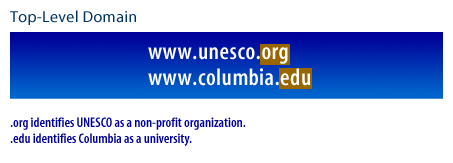
A top-level domain is the right-most label in a domain name. In unesco.org, the TLD is .org. In gov.uk, the far-right TLD is .uk.
TLDs help organize the namespace, but they no longer carry the rigid meanings that many older lessons suggested. Historically, several original generic domains became strongly associated with certain categories:
TLDs help organize the namespace, but they no longer carry the rigid meanings that many older lessons suggested. Historically, several original generic domains became strongly associated with certain categories:
Common Legacy TLD Meanings
| TLD | Traditional Meaning | Typical Historical Association |
| .com | Commercial | Businesses and commercial entities |
| .edu | Education | Accredited postsecondary institutions in the United States |
| .gov | Government | U.S. government entities |
| .int | International | Organizations established by treaty |
| .mil | Military | U.S. military |
| .net | Network | Originally network-related providers; now broad general use |
| .org | Organization | Nonprofits, communities, foundations, and other organizations |
That historical table is still useful for orientation, but modern Web deployment is more flexible. Many TLDs are now used for branding, geography, audience targeting, or campaign design rather than strict organizational classification. A startup may use .io, a nonprofit may still prefer .org, a software team might choose .dev, and a country code domain can be selected either for local identity or for marketing value.
In other words, the TLD still matters, but its role is now strategic as well as descriptive.
In other words, the TLD still matters, but its role is now strategic as well as descriptive.
Country-Code Top-Level Domains
The second major category of TLD is the country-code top-level domain (ccTLD). These domains are associated with countries, territories, or geographic communities. Examples include .us, .uk, .de, .jp, and many others.
Country-code domains can serve several purposes:
For digital presence strategy, ccTLDs remain important because they can communicate locality more directly than a generic TLD. A business targeting one country may choose a ccTLD to reinforce regional identity, while a global brand may prefer a generic TLD and then localize content through directories, subdomains, or language targeting.
Country-code domains can serve several purposes:
- They can signal local presence and geographic relevance.
- They can support region-specific legal, language, or tax requirements.
- They can improve trust when a site is intended for users in a particular country.
- They can be used creatively for branding in cases where the letters also form a marketable ending.
For digital presence strategy, ccTLDs remain important because they can communicate locality more directly than a generic TLD. A business targeting one country may choose a ccTLD to reinforce regional identity, while a global brand may prefer a generic TLD and then localize content through directories, subdomains, or language targeting.
Second-Level Domains and Subdomains
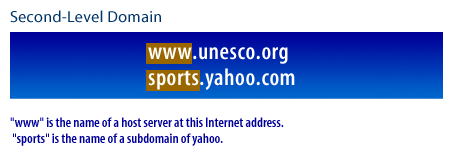
The second-level domain is the label immediately to the left of the TLD. In example.com, the second-level domain is example. This is often the part selected during domain registration because it usually reflects the organization, brand, publication, product, or project name.
Additional labels may be added to the left of the second-level domain. These labels are commonly called subdomains. For example:
Additional labels may be added to the left of the second-level domain. These labels are commonly called subdomains. For example:
- www.example.com
- blog.example.com
- shop.example.com
- support.example.com
- api.example.com might expose application programming interfaces.
- docs.example.com might host developer documentation.
- status.example.com might publish availability reports.
- learn.example.com might host a training platform.
Hosts, Services, and Modern DNS Records
A domain name does not simply “point to a website.” Instead, DNS can publish different record types for different purposes.
Common record types include:
For contemporary deployment, domain planning is tied closely to:
Common record types include:
- A records for IPv4 addresses
- AAAA records for IPv6 addresses
- CNAME records for aliases
- MX records for mail routing
- NS records for authoritative name servers
- TXT records for verification, email policy, and other metadata
For contemporary deployment, domain planning is tied closely to:
- HTTPS certificate management
- DNS hosting providers
- CDN and reverse proxy configuration
- Email authentication such as SPF, DKIM, and DMARC
- DNSSEC support
- Cloud and edge routing patterns
Outdated Approaches Versus Contemporary Techniques
Older Web deployment lessons often reflected a world of single servers, fixed hosting accounts, T1 or T3 leased lines, static IP assumptions, and limited TLD choices. That model helped explain the basics, but it no longer represents the dominant deployment pattern.
Modern practice is different in several ways:
Modern practice is different in several ways:
- Connectivity: Dedicated legacy circuit language is less central today. Businesses more commonly use fiber, cable, managed broadband, SD-WAN, and direct cloud connectivity where needed.
- Hosting: Instead of one physical server per site, organizations often deploy on cloud platforms, containers, managed hosting, serverless environments, and global edge networks.
- DNS management: DNS changes are typically handled through registrar dashboards, managed DNS providers, infrastructure-as-code pipelines, or cloud control planes.
- Security: Modern sites are expected to use TLS certificates, redirect HTTP to HTTPS, protect DNS zones, and verify domain ownership for email and platform integrations.
- Brand strategy: Domain selection now reflects search visibility, memorability, international reach, trust, and product segmentation.
Domain Names Within a Modern Digital Presence
A domain name is not just a technical label. It is part of digital presence management. In a modern web strategy, the domain helps shape:
- Brand recognition
- User trust
- Search discoverability
- Email credibility
- Campaign tracking
- Environment separation such as production, staging, and testing
- www.example.com for the main site
- shop.example.com for commerce
- blog.example.com for content marketing
- status.example.com for service availability
- m.example.com in legacy mobile strategies, although responsive design has largely reduced the need for separate mobile hostnames
Modern Tooling for Domain Management
Today’s domain management usually involves more than purchasing a name. Teams commonly work with:
- Domain registrars for registration and renewal
- Managed DNS platforms for zone control
- Cloud providers for application routing
- Certificate services for HTTPS
- Web server and proxy platforms such as Nginx, Apache, or managed edge services
- Developer tools for testing DNS propagation, SSL configuration, redirects, and performance
Interpreting the Example Figures
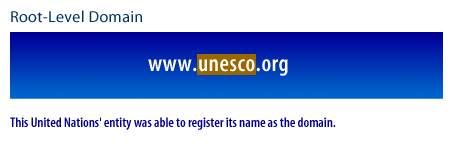
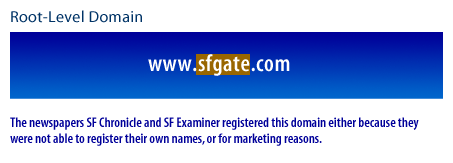
The following series of images illustrates how domains are assigned and interpreted in practice. Read them as examples of naming structure, institutional identity, and the relationship between labels in a domain name.
Conclusion
Domain levels are best understood as part of a hierarchical naming system that supports the entire Web. The root sits at the top of the namespace. The TLD appears at the far right. The second-level domain usually identifies the organization, brand, or project. Additional labels to the left can define hosts, services, or subdomains.
That foundational structure has not changed, but the way organizations use domains has evolved significantly. Modern web deployment combines domain planning with cloud hosting, CDN routing, HTTPS, DNS security, email authentication, and international branding. As a result, domain names are no longer just addresses; they are operational, architectural, and strategic assets.
In the next lesson, domain registration will be discussed in greater detail.
That foundational structure has not changed, but the way organizations use domains has evolved significantly. Modern web deployment combines domain planning with cloud hosting, CDN routing, HTTPS, DNS security, email authentication, and international branding. As a result, domain names are no longer just addresses; they are operational, architectural, and strategic assets.
In the next lesson, domain registration will be discussed in greater detail.