| Lesson 8 | Mapping to business concerns |
| Objective | Business concerns that must be addressed by your site |
Mapping to Business Concerns
Every decision made during the storyboard and planning phase must map back to a justifiable business requirement. Before committing to a particular site element, service, or technology, stop and ask: why does the business need this, and what happens if it is absent? The discipline of mapping technical decisions to business concerns prevents scope creep, controls costs, and ensures the finished site delivers measurable value rather than features that seemed useful during planning but serve no defined business goal.
Beyond the functional requirements of the site itself, a broader set of business concerns must be resolved — particularly for e-commerce sites that will serve customers across multiple regions or countries. These concerns span operations, finance, legal compliance, and customer support.
Beyond the functional requirements of the site itself, a broader set of business concerns must be resolved — particularly for e-commerce sites that will serve customers across multiple regions or countries. These concerns span operations, finance, legal compliance, and customer support.
Core Business Concerns
The following business concerns apply to virtually every e-commerce implementation and must be addressed during the planning phase before development begins:
Because an e-commerce site is accessible to anyone, the business must also plan how it will handle the financial proceeds from transactions — particularly across different currencies, payment methods, and settlement timelines.
- Record the customer's information — customer accounts, contact details, purchase history, preferences, and communication consent must be captured accurately, stored securely, and maintained in compliance with applicable data-protection regulations including GDPR, CCPA, and their equivalents in other jurisdictions
- Process the order accurately — the order management system must capture the correct product, variant, quantity, price, and applicable discount; calculate and apply the correct tax; and transmit the confirmed order to fulfillment without data loss or transformation errors between systems
- Ship the product — physical goods require carrier API integration, shipping label generation, tracking number capture, and automated customer notification at each stage of fulfillment; digital goods require secure delivery mechanisms and access control that prevent unauthorized distribution
- Deal with customer feedback including complaints — a defined, staffed process for handling returns, refunds, exchanges, chargebacks, and complaint escalations must be built into both the site and the operations behind it before launch, not after the first complaint arrives
- Pre-sales inquiries and sales tracking — the site must support customers who are not yet ready to purchase through product questions, comparison tools, saved wishlists, and quote requests; it must also track the path from first visit to conversion so that marketing spend can be attributed and the funnel optimized
- Online sales support — live chat, chatbot, help center articles, and contact options must be available at the moments customers need them most, which are typically during the checkout process and immediately after a purchase is completed
- Building a sense of community — customers who feel connected to a brand return more frequently and spend more over their lifetime; community is built through loyalty programs, product lifecycle communications, new offering announcements, upgrade notifications, and direct engagement channels
Because an e-commerce site is accessible to anyone, the business must also plan how it will handle the financial proceeds from transactions — particularly across different currencies, payment methods, and settlement timelines.
Global E-Commerce Business Concerns
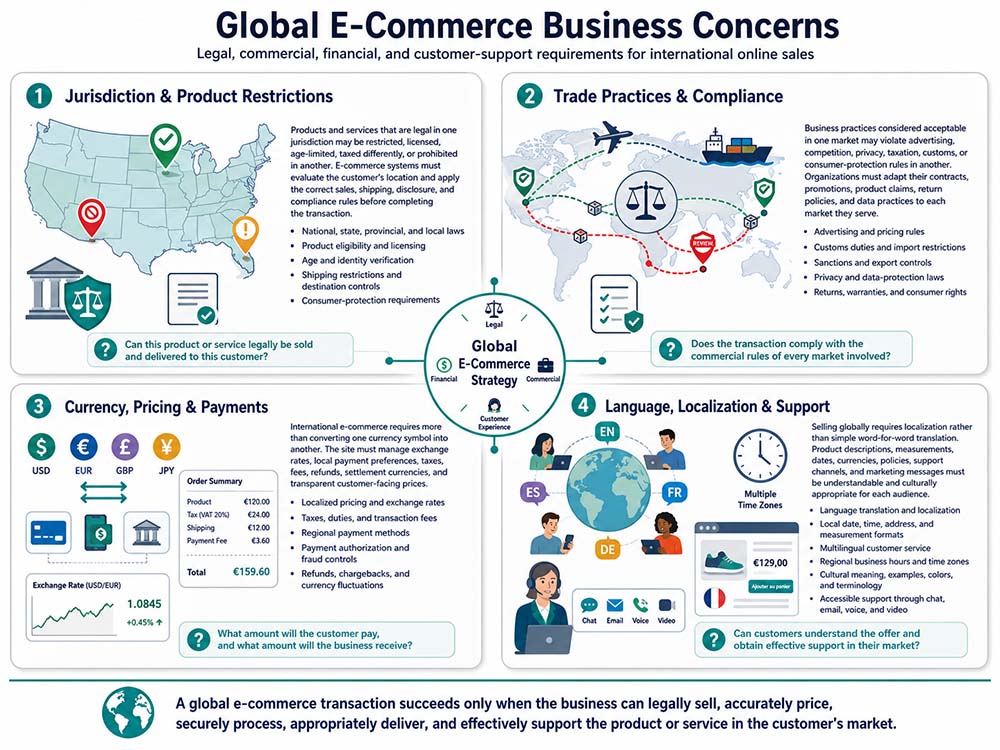
The four quadrants of the figure above represent the principal business concerns that arise when an e-commerce site serves customers in more than one market. Each quadrant connects to the central Global E-Commerce Strategy through one of four dimensions: Legal, Commercial, Financial, and Customer Experience. Ignoring any one of these dimensions creates exposure — legal liability, commercial disputes, payment failures, or customers who cannot complete a purchase or obtain support in their own language.
Jurisdiction and Product Restrictions
Products and services that are legal in one jurisdiction may be restricted, licensed, age-limited, taxed differently, or prohibited in another. The e-commerce system must evaluate the customer's location and apply the correct sales rules, shipping options, disclosure requirements, and compliance checks before completing the transaction — not after.
The framing question for this quadrant is: Can this product or service legally be sold and delivered to this customer?
The framing question for this quadrant is: Can this product or service legally be sold and delivered to this customer?
- National, state, provincial, and local laws vary significantly by product category — what is unrestricted in one state may require a license or be banned in a neighboring one
- Product eligibility and licensing requirements differ by destination and must be verified at the point of sale, not at the point of shipment
- Age and identity verification may be legally required for certain product categories before the transaction can proceed
- Shipping restrictions and destination controls apply to a wide range of physical goods including electronics, food, pharmaceuticals, and hazardous materials
- Consumer-protection disclosure requirements — mandatory cooling-off periods, returns rights, and pricing transparency rules — vary significantly by market
Trade Practices and Compliance
Business practices considered acceptable in one market may violate advertising, competition, privacy, taxation, customs, or consumer-protection rules in another. Organizations must adapt their contracts, promotions, product claims, return policies, and data practices to each market they serve rather than applying a single global policy.
The framing question for this quadrant is: Does the transaction comply with the commercial rules of every market involved?
The framing question for this quadrant is: Does the transaction comply with the commercial rules of every market involved?
- Advertising and pricing rules — prohibited claims, mandatory price disclosures, and comparative advertising restrictions vary by jurisdiction
- Customs duties and import restrictions on physical goods must be calculated and disclosed before the customer completes checkout
- Sanctions and export controls restrict sales to certain countries, entities, or individuals and must be checked against current lists in real time
- Privacy and data-protection laws — GDPR in the EU, PIPL in China, CCPA in California — impose specific consent, retention, and processing obligations that vary by where the customer is located
- Returns, warranties, and consumer rights that exceed the seller's standard policy may be legally mandated in certain markets
Currency, Pricing, and Payments
International e-commerce requires more than converting one currency symbol into another. The site must manage exchange rates, local payment preferences, taxes, fees, refunds, settlement currencies, and transparent customer-facing prices that reflect the total cost the customer will actually pay.
The framing question for this quadrant is: What amount will the customer pay, and what amount will the business receive?
The framing question for this quadrant is: What amount will the customer pay, and what amount will the business receive?
- Localized pricing and real-time exchange rate management — prices displayed in the customer's currency must be accurate and updated as exchange rates move
- Taxes, duties, and transaction fees that vary by origin, destination, and product type must be calculated at checkout and disclosed before the customer commits to purchase
- Regional payment methods — credit cards are not dominant in every market; local digital wallets, bank transfers, cash-on-delivery, and buy-now-pay-later products vary significantly by region and must be supported to avoid abandonment
- Payment authorization and fraud controls must be calibrated for each market's risk profile — rules that reduce fraud in one market may block legitimate transactions in another
- Refunds, chargebacks, and currency fluctuation risk between the time of transaction and the time of settlement must be planned for in the financial model
Language, Localization, and Customer Support
Selling globally requires genuine localization rather than simple word-for-word translation. Product descriptions, measurements, dates, currencies, policies, support channels, and marketing messages must be understandable and culturally appropriate for each audience. A technically capable site that customers cannot navigate in their own language or contact for support in their time zone will not convert.
The framing question for this quadrant is: Can customers understand the offer and obtain effective support in their market?
The framing question for this quadrant is: Can customers understand the offer and obtain effective support in their market?
- Language translation and localization of all customer-facing content — product pages, checkout, confirmation emails, and support documentation
- Local date, time, address, and measurement formats — presenting dates, weights, and dimensions in the format customers expect reduces confusion and returns
- Multilingual customer service across all support channels — chat, email, voice, and video
- Regional business hours and time zone coverage for live support — a support team that operates only in one time zone cannot effectively serve customers globally
- Cultural meaning of colors, examples, imagery, and terminology — what communicates trust and quality in one culture may communicate something entirely different in another
Transaction Proceeds and Financial Reconciliation
Planning for how the business will handle the financial proceeds of transactions is a required part of the mapping exercise, not an afterthought. Questions to resolve during the planning phase:
- Which payment gateway or payment service provider will process transactions, and in which currencies will it settle?
- How will multi-currency settlements be reconciled against orders placed in different currencies?
- What are the chargeback and fraud exposure thresholds, and what technical and operational controls will mitigate them?
- How will tax collected from customers be reported and remitted to the appropriate authorities in each jurisdiction where the business has nexus?
- What is the refund and cancellation policy, and how is it implemented technically in the order management and payment systems?
Intellectual Property and the Web
The accessibility of the internet leads some to assume that content can be freely borrowed from any site. This is not the case. A properly implemented e-commerce site represents a significant investment of time, money, and creative effort that its owner has the right to protect. Close imitation — even when not legally actionable — damages the imitating site's reputation with both users and search engines.
Intellectual property concerns that must be addressed during planning:
Intellectual property concerns that must be addressed during planning:
- Copyright — you cannot reproduce another site's product descriptions, images, written content, or design elements without permission, even if they are publicly visible and freely accessible
- Plagiarism — reusing both the content and the specific expression of another site's material creates legal exposure and signals low quality to search engines, harming organic rankings
- Trademark — product names, brand names, and logos belong to their registered owners; unauthorized use in product listings, advertising, or site copy creates legal liability
- Patent — certain e-commerce processes, checkout flows, and recommendation mechanisms are subject to patent protection; due diligence is required before implementing technically novel features
Support Staff and Operational Costs
If the site requires any type of support services — a help desk, live chat, online sales support, or returns processing — the associated staffing costs must be planned as part of the business model from the outset. An e-commerce site is a business operation, not only a technical implementation, and it requires ongoing human resources to function effectively.
Support staffing areas to plan for:
Support staffing areas to plan for:
- Help desk and technical support — handling login issues, order status questions, payment problems, and product inquiries requires trained staff or a well-configured self-service system capable of deflecting the most common queries
- Online sales support — pre-purchase guidance, product comparison assistance, and quote generation for higher-value or more complex products may require dedicated sales staff rather than automated responses
- Returns and complaints handling — a defined, staffed process for returns, refunds, and escalations must exist before launch; the process cannot be designed reactively after the first wave of complaints arrives
- Content and catalog maintenance — product listings, pricing, images, availability, and promotional content must be kept current on an ongoing basis; this is a recurring operational commitment, not a one-time implementation task
In the next lesson, you will learn about outsourcing solutions for e-commerce implementation.