Planning E-Commerce Website Implementation: Strategic Foundation
E-commerce implementation planning determines success or failure before a single line of code executes—rushing into platform selection, design, or development without strategic foundation creates technical debt, missed requirements, budget overruns, and eventual abandonment of half-built systems. This module introduces systematic planning methodology transforming business objectives into executable implementation roadmap spanning design goals, revenue strategies, product organization, interface requirements, technical infrastructure, and security architecture. Effective planning isn't bureaucratic overhead delaying launch—it's investment preventing expensive mid-project pivots when discovering platform choice doesn't support required functionality, chosen payment gateway doesn't serve target markets, or performance assumptions prove unrealistic under actual traffic. Modern e-commerce offers unprecedented platform variety—Shopify for rapid deployment, WooCommerce for WordPress integration, BigCommerce for enterprise features, headless commerce for omnichannel experiences—each optimized for different scenarios. Planning identifies which scenario describes your business, aligns platform capabilities with requirements, and sequences implementation activities avoiding dependencies blocking progress. Whether launching new store, migrating from legacy platform (osCommerce, Zen Cart, Magento 1.x), or expanding existing business into e-commerce, systematic planning methodology this module introduces provides framework ensuring implementation effort delivers business value rather than technically functional but commercially unsuccessful website.
Why Planning Matters: Common Implementation Failures
E-commerce implementation failures rarely result from technical incompetence—more often they stem from insufficient planning exposing misaligned expectations, unstated requirements, or unrealistic assumptions only after substantial investment. Platform mismatch represents frequent failure mode: selecting Shopify for complex B2B requirements needing custom pricing tiers, approval workflows, and contract management functionality Shopify constrains, or choosing Magento for simple retail store creating operational burden exceeding organizational capacity for server administration and ongoing maintenance. These mismatches become apparent mid-implementation when discovering required functionality demands extensive custom development or platform switching—scenarios planning prevents through explicit requirements documentation and platform evaluation against those requirements.
Scope creep destroys budgets and timelines when implementation begins without defined boundaries. Initial "simple online store" expands incorporating subscription management, marketplace capabilities, international selling, mobile app, wholesale portal, and inventory integration with retail stores—each addition reasonable individually but collectively transforming manageable project into multi-year enterprise implementation. Planning establishes scope boundaries, sequences features into phases, and creates change management process preventing ad-hoc additions derailing core implementation.
Integration surprises emerge when planning overlooks backend system dependencies. E-commerce sites rarely operate standalone—they require inventory synchronization with warehousing systems, order export to fulfillment partners, customer data sharing with CRM platforms, sales tax calculation through automation services, and financial data flow to accounting software. Discovering mid-implementation that chosen platform lacks required integration capabilities, third-party systems expose incompatible APIs, or integration costs exceed platform costs themselves creates expensive pivots planning should identify upfront.
Performance assumptions prove unrealistic when planning neglects capacity analysis. Assumptions like "Shopify handles scaling" work until discovering Shopify app combinations slow page loads to 5+ seconds, or self-hosted WooCommerce assumptions about "standard hosting" collapse under traffic spikes requiring expensive infrastructure upgrades mid-promotion. Planning includes performance requirements, load testing, and infrastructure capacity analysis preventing launch-day failures when traffic exceeds optimistic assumptions.
Security and compliance gaps discovered late create launch delays or legal exposure. Discovering regulatory requirements (GDPR data protection, accessibility standards, industry-specific compliance) demand functionality chosen platform lacks or requires expensive custom development transforms launch timeline. Planning identifies regulatory requirements early, evaluates platform compliance capabilities, and allocates budget for necessary compliance implementations.
Planning Framework Overview
Systematic e-commerce planning follows structured framework spanning business strategy through technical architecture, ensuring implementation decisions align with commercial objectives rather than technical preferences. This framework adapts across implementation scales—small business rapid deployment compresses planning into days rather than weeks, while enterprise migrations require months of detailed requirements analysis—but core components remain constant.
Strategic planning establishes business foundation: target market definition, competitive positioning, revenue model, and success metrics. Without strategic clarity, technical decisions lack context—how can you evaluate platform checkout flows without understanding whether your business optimizes for impulse purchases (streamlined one-click) versus considered purchases (detailed product information and comparison tools)? Strategic planning answers "why e-commerce?" and "what makes our approach competitive?" before addressing "how do we build it?"
Requirements gathering translates strategy into functional specifications: product catalog structure and complexity, customer account features, checkout workflow requirements, payment method support, shipping calculation needs, tax compliance requirements, and reporting capabilities. Requirements provide objective criteria evaluating platforms and vendors rather than subjective preferences or feature lists disconnected from business needs.
Platform evaluation assesses options against requirements: hosted platforms (Shopify, BigCommerce), self-hosted systems (WooCommerce, Magento), headless commerce APIs (Commerce.js, Saleor), or custom development. Evaluation considers total cost of ownership including hosting, maintenance, security, compliance, and opportunity costs, not merely licensing or development costs in isolation.
Architecture design defines technical structure: monolithic platform architecture versus headless separation of frontend and commerce logic, integration patterns for backend systems, security architecture across multiple layers, and performance optimization strategies. Architecture decisions prove expensive to reverse—planning prevents "build now, architect later" approaches creating technical debt.
Implementation roadmap sequences activities, identifies dependencies, allocates resources, and establishes milestones. Roadmap provides realistic timeline accounting for complexities like data migration from legacy systems, integration development, content creation, and testing rather than optimistic "how long to build checkout page?" calculations ignoring dependencies.
Risk analysis identifies potential failures and mitigation strategies: what happens if chosen payment gateway doesn't support target market? What's backup if key integration partner changes API? How do we handle traffic spikes beyond projected capacity? Risk analysis prevents single points of failure through contingency planning.
Design Goals: Aligning Implementation with Business Objectives
Design goals translate business strategy into implementation priorities guiding platform selection, feature prioritization, and resource allocation decisions. Effective design goals prove specific, measurable, achievable, relevant, and time-bound rather than vague aspirations like "best user experience" lacking actionable guidance.
Conversion optimization as design goal prioritizes checkout flow simplification, trust signal reinforcement (security badges, customer reviews, guarantees), and friction reduction through features like guest checkout, Apple Pay/Google Pay support, and transparent shipping cost calculation. Platforms and features evaluate against contribution to conversion rate improvement—does this feature move customers toward purchase or merely add complexity?
Average order value maximization drives different priorities: product recommendation algorithms, "frequently bought together" suggestions, volume discount presentation, and upsell/cross-sell opportunities at checkout. Implementation emphasizes features like sophisticated product relationship management, dynamic pricing rules, and personalization capabilities supporting revenue per transaction increase.
Customer lifetime value development shifts focus toward repeat purchase facilitation: customer account features, wish lists, reorder convenience, email marketing integration for abandoned cart recovery and lifecycle campaigns, and subscription options converting one-time purchases into recurring revenue. Platform selection weighs customer relationship management capabilities and marketing automation integration over one-time transaction optimization.
Operational efficiency prioritizes automation reducing manual workload: automated inventory management, shipping label generation, tax calculation, fraud detection, and order routing to fulfillment partners. Evaluation focuses on integration capabilities with backend systems and workflow automation features over customer-facing capabilities—recognizing operational costs constrain profitability regardless of conversion rate.
Market expansion flexibility emphasizes scalability and adaptability: internationalization support (multi-currency, language localization, regional inventory), marketplace integration (Amazon, eBay), wholesale/B2B capabilities alongside retail, and omnichannel architecture supporting future mobile apps or retail store integration. Platform selection weighs architectural flexibility and ecosystem richness over immediate feature completeness.
Design goals conflict—conversion optimization and operational efficiency sometimes pull opposing directions—requiring prioritization establishing primary versus secondary objectives guiding tradeoff decisions. Planning documents these priorities preventing mid-implementation debates about feature importance.
Revenue Strategies and Business Model Alignment
E-commerce revenue models span far beyond simple "sell products online"—understanding revenue strategy shapes platform requirements and implementation priorities substantially. Direct product sales represent straightforward model but variations exist: high-volume low-margin (requiring aggressive conversion optimization and operational efficiency) versus low-volume high-margin (emphasizing product presentation and customer service), commodity products (competing on price and convenience) versus unique products (building brand and customer relationships).
Subscription commerce requires platforms supporting recurring billing, subscription management (pause, cancel, upgrade/downgrade), failed payment recovery, and customer lifecycle automation. Shopify, BigCommerce, and WooCommerce offer subscription apps, but evaluation must verify functionality completeness—some "subscription support" proves limited requiring extensive customization. Subscription businesses optimize for customer retention over acquisition, demanding analytics and communication tools supporting churn reduction.
Marketplace models connecting multiple sellers with buyers introduce complexity absent from single-vendor implementations: seller onboarding and management, commission calculation and payment splitting, dispute resolution, seller performance analytics, and compliance across multiple vendors. Platform selection narrows to marketplace-specific solutions (Sharetribe, CS-Cart Multi-Vendor) or enterprise platforms with marketplace capabilities (Magento, custom development), as standard e-commerce platforms lack marketplace functionality.
Digital products and services (software, courses, memberships, consultations) eliminate physical fulfillment but introduce digital delivery, license management, access control, and content protection requirements. Platforms vary significantly in digital product support—Shopify and WooCommerce handle basic digital delivery, but sophisticated digital product businesses often require specialized platforms (Podia, Teachable for courses; Memberful, Patreon for memberships) or custom development.
B2B e-commerce serves commercial buyers requiring quote generation, bulk pricing, purchase order workflows, credit terms, approval hierarchies, and contract pricing invisible to B2C implementations. Magento, BigCommerce, and custom platforms offer B2B capabilities; Shopify Plus added B2B features but with constraints. B2B planning identifies specific workflow requirements preventing platform selection assuming B2C functionality suffices with minor additions.
Omnichannel commerce integrating online sales with retail stores, mobile apps, marketplaces, and social selling demands unified inventory, customer data, and order management across channels. Architecture planning for omnichannel often favors headless commerce separating commerce logic (managed centrally) from channel-specific frontends, though operational complexity exceeds single-channel implementations substantially.
Products and Services: Catalog Structure and Complexity
Product catalog characteristics fundamentally influence platform selection and implementation complexity. Simple catalogs (dozens to low hundreds of products, minimal variants, straightforward categorization) work with any platform—implementation focuses on presentation and conversion rather than catalog management sophistication. Complex catalogs (thousands of products, extensive variants, deep category hierarchies, configurable options, bundling, product relationships) demand robust catalog management, performance optimization for large databases, and sophisticated search and filtering.
Product variants (size, color, material combinations) require platforms supporting variant management properly—some systems treat variants as separate products creating management burden and reporting complications; better systems handle variants as single product with options. Variant complexity—simple (3 sizes, 4 colors = 12 SKUs) versus complex (configurable products with interdependent options creating hundreds of combinations)—determines whether standard variant management suffices or custom configurator development required.
Digital assets (product images, videos, downloadable specifications, 360-degree views) impact storage, bandwidth, and presentation requirements. Planning catalogs expected media richness—basic product photos versus extensive lifestyle photography, product videos, size guides, assembly instructions—informs hosting infrastructure and CDN requirements. Modern expectations favor rich media, but implementation must budget storage costs and content creation effort.
Product information management for catalogs sourced from manufacturers, distributors, or managed across multiple channels often requires dedicated PIM systems integrating with e-commerce platforms. Planning identifies whether simple spreadsheet imports suffice or PIM integration necessary preventing manual product data duplication and synchronization burden.
Inventory management complexity varies dramatically: single warehouse location versus multi-location inventory with allocation rules, make-to-order versus stock items, serialized inventory tracking, expiration date management, or consignment inventory. Platform evaluation must verify inventory management matches business model—platforms handling simple inventory struggle with distribution center operations or made-to-order manufacturing workflows.
Pricing complexity—volume discounts, customer-specific pricing, regional pricing, promotional pricing, dynamic pricing based on inventory or demand—requires platform support for pricing rules. B2B businesses particularly require sophisticated pricing, while B2C often manages with simpler discount codes and sale pricing.
Web Interface Requirements and User Experience
Web interface planning defines customer-facing experience requirements guiding design and development priorities. Mobile-first design acknowledges mobile traffic dominance (60%+ for many industries) demanding touch-optimized interfaces, simplified navigation, and performance optimization for mobile networks. Planning establishes whether mobile-responsive design suffices or Progressive Web App or native mobile app development required based on customer behavior and competitive analysis.
Checkout workflow significantly impacts conversion—planning defines requirements: guest checkout support (improves conversion but complicates remarketing), one-page versus multi-step checkout, address validation and autocomplete, shipping method selection, payment method variety, and order confirmation/tracking. Modern checkout increasingly incorporates Apple Pay and Google Pay for mobile conversion improvement—planning identifies whether payment gateway selection must prioritize digital wallet support.
Search and navigation requirements scale with catalog complexity. Small catalogs require basic search and category browsing; large catalogs demand faceted search (filter by multiple attributes simultaneously), intelligent search (handling typos, synonyms, plural variations), autocomplete suggestions, and sophisticated category structures. Platform evaluation verifies search capabilities match catalog complexity—Shopify's basic search proves inadequate for large catalogs without app extensions; Magento offers more sophisticated built-in search but requires configuration.
Personalization ranges from basic ("recommended for you" based on browsing history) to sophisticated (dynamic content and pricing based on customer segment, behavior, and predicted intent). Planning establishes personalization priorities and evaluates platform capabilities or integration with personalization services (Dynamic Yield, Nosto)—personalization provides competitive advantage but implementation complexity and cost vary dramatically across approaches.
Accessibility compliance (WCAG 2.1 AA standards) proves legally required in many jurisdictions and improves usability universally. Planning includes accessibility requirements and platform evaluation of accessibility support—some themes and platforms provide better accessibility foundation than others, though all require testing and potential remediation.
Archetypes: Modeling E-Commerce Patterns
Archetypes provide reusable templates representing common e-commerce structures, behaviors, and processes—standardized patterns accelerating implementation while ensuring completeness. Rather than designing every workflow from scratch, archetypes offer proven patterns adaptable to specific business needs. Modern platform development increasingly recognizes archetype patterns through built-in templates, though understanding underlying patterns enables customization aligning with business requirements.
Data modeling archetypes define standard structures: Product archetype specifies attributes (SKU, name, description, price, inventory, images, variants), relationships (categories, related products, cross-sells), and behaviors (inventory deduction, pricing calculations). Customer archetype defines profile data, addresses, payment methods, order history, and preferences. Order archetype structures order information, line items, totals, payment transactions, shipping details, and status tracking. These archetypes ensure consistency across implementation preventing ad-hoc data structures creating integration problems.
Business process archetypes standardize workflows: Order fulfillment archetype models progression from order placement through payment processing, inventory allocation, pick/pack/ship operations, tracking updates, and delivery confirmation. Inventory management archetype defines replenishment workflows, stock transfers, returns processing, and cycle counting. Customer service archetype structures inquiry handling, returns processing, and complaint resolution. Platforms embodying these archetypes through configured workflows rather than custom development accelerate implementation while ensuring process completeness.
User interaction archetypes define customer journey patterns: Product discovery archetype encompasses search, filtering, category browsing, and product comparison. Checkout archetype sequences cart review, shipping information entry, payment method selection, and order confirmation. Account management archetype provides profile management, order history viewing, reorder functionality, and preference setting. These archetypes inform UX design ensuring customer-facing flows align with established patterns customers understand.
System architecture archetypes represent structural patterns: Monolithic archetype describes traditional all-in-one platforms (Shopify, standard WooCommerce) handling all functions within unified application—simple deployment but limited flexibility. Microservices archetype decomposes functionality into independent services (product service, order service, payment service, inventory service) communicating via APIs—complex deployment but independent scaling and technology choice per service. Event-driven archetype implements asynchronous communication through event messaging (order placed event triggers inventory deduction, fulfillment notification, analytics tracking)—loosely coupled but requires message queue infrastructure. Headless commerce archetype separates frontend presentation from commerce backend via APIs—omnichannel flexibility but increased architectural complexity.
Domain-specific archetypes address specialized requirements: B2B archetype incorporates quote management, approval workflows, account-based pricing, and purchase order support. Marketplace archetype adds seller management, commission calculation, multi-vendor fulfillment, and dispute resolution. Subscription archetype includes recurring billing, subscription lifecycle management, dunning processes, and churn prevention workflows. Recognizing your domain archetype guides platform selection toward solutions designed for that pattern rather than forcing general-purpose platforms into specialized uses through extensive customization.
Archetype-based planning creates common vocabulary for stakeholder communication, provides completeness checklists ensuring no critical functionality overlooked, and accelerates development through pattern reuse. Modern low-code and no-code platforms increasingly surface archetypes as configurable templates rather than requiring code-level implementation, democratizing sophisticated e-commerce capabilities.
Storyboarding Implementation Flow
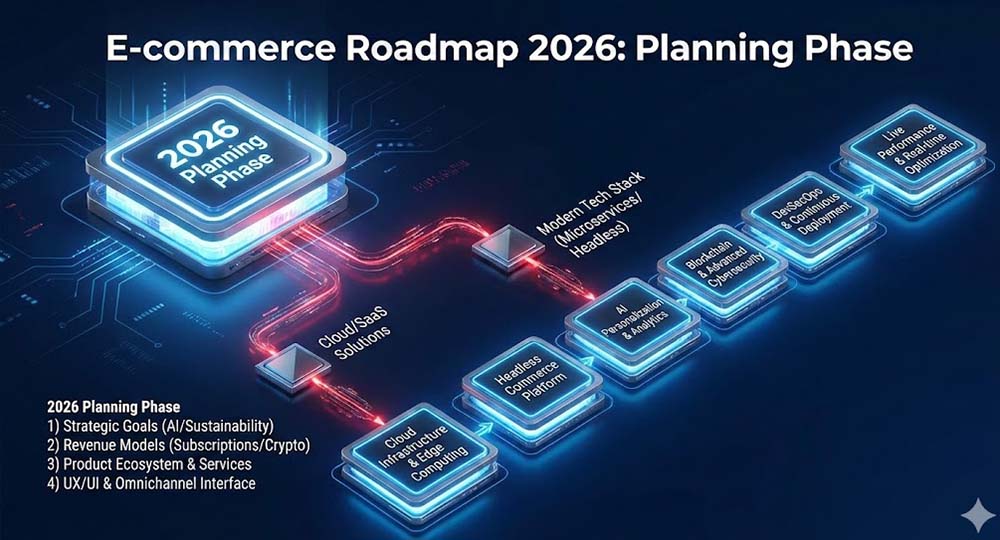
Storyboards visualize implementation workflow sequencing activities, identifying dependencies, and clarifying decision points through diagrams communicating complex processes more effectively than textual requirements. E-commerce storyboards map customer journeys (how shoppers discover, evaluate, and purchase products) and implementation workflows (how projects progress from planning through deployment).
E-Commerce Implementation Workflow Storyboard
This storyboard illustrates systematic progression from strategic planning through deployment, emphasizing decision points and activity sequencing preventing dependency conflicts.
Phase 1: Planning (Foundation)
Design Goals: Define conversion optimization, brand alignment, user experience priorities
Revenue Strategies: Establish business model (direct sales, subscriptions, marketplace, B2B)
Products and Services: Document catalog structure, complexity, variant management requirements
Web Interface: Specify customer journey, checkout workflow, search/navigation needs
Critical Decision Point: Build vs. Outsource
Outsource: Engage agency or freelancers for implementation leveraging specialized expertise
In-House Development: Internal team builds using existing technical capacity
Phase 2: Infrastructure (if In-House)
Hardware and Operating System: Provision servers (cloud, VPS, dedicated) or leverage managed platform hosting
Web Server Software: Configure Apache, Nginx, or platform-provided infrastructure
E-Commerce Software: Install and configure platform (WooCommerce, Magento) or integrate with hosted solution
Performance analysis positioned post-deployment acknowledging optimization as ongoing process
Storyboard evolution throughout course adds detail to each phase—subsequent modules expand planning considerations, infrastructure requirements, security implementations, and performance optimization techniques. This progressive elaboration prevents overwhelming initial planning while ensuring comprehensive coverage across implementation lifecycle.
Storyboarding benefits extend beyond project visualization: they facilitate stakeholder alignment (business, technical, and marketing participants understand project flow), support resource planning (identifying when specialized skills required), and enable risk identification (visualizing dependencies reveals blocking scenarios). Modern storyboarding tools (Miro, Lucidchart, Figma) support collaborative editing enabling distributed teams contributing to planning process.
Outsourcing vs. In-House Development
Build-versus-outsource represents critical planning decision influencing budget, timeline, ongoing maintenance, and organizational capability development. Outsourcing to agencies or freelancers accelerates implementation leveraging specialized e-commerce expertise, provides access to designers and developers whose full-time employment would exceed budget, and delivers complete solutions without building internal capability. However, outsourcing creates vendor dependency for ongoing maintenance and enhancements, knowledge transfer challenges when bringing functions in-house later, and potential cost overruns if requirements prove unclear or scope expands.
In-house development builds internal organizational capability, provides direct control over implementation priorities and timeline, eliminates vendor coordination overhead, and creates institutional knowledge supporting long-term platform evolution. However, in-house requires recruiting or training e-commerce technical expertise, typically extends implementation timeline compared to experienced agencies, and may produce lower quality if team lacks platform-specific experience.
Hybrid approaches increasingly common: outsource initial implementation to agency while staffing internal maintenance and enhancement capability, or handle frontend/design internally while outsourcing complex backend integration work. Planning identifies which activities benefit from external expertise versus internal control, creates knowledge transfer requirements ensuring outsourced work remains maintainable internally, and establishes ongoing relationship models (retainer for continued agency support, transition to full internal ownership, or partnership for major enhancements).
Outsourcing evaluation requires detailed requirements documentation and scope definition—vague requirements produce cost overruns and delivered functionality mismatched to actual needs. Request for Proposal (RFP) processes soliciting competitive bids, reference checking with past clients, and portfolio review ensure vendor selection aligns with project requirements and budget realities. In-house development demands realistic capability assessment—"we have developers" doesn't ensure "we have e-commerce platform expertise"—and potentially training investment or strategic hiring before committing to internal build.
Modern Platform Considerations
Contemporary e-commerce landscape offers platform diversity unimaginable a decade ago—planning must navigate options aligned with organizational capabilities and business requirements. Shopify dominates hosted SaaS for good reason: rapid deployment (functional store in days), managed infrastructure (hosting, security, PCI compliance, scaling handled automatically), extensive app ecosystem extending functionality, and predictable subscription pricing. However, Shopify constrains customization within its architecture, charges transaction fees when using third-party payment gateways, and proves expensive at scale when app subscriptions accumulate.
WooCommerce leads WordPress e-commerce through free plugin providing infinite customization potential within WordPress ecosystem. Organizations with WordPress expertise naturally extend into e-commerce via WooCommerce, leveraging existing hosting and content management familiarity. However, WooCommerce requires separate hosting, security hardening, performance optimization, and ongoing maintenance—total cost of ownership including operational effort often exceeds Shopify despite "free" software.
BigCommerce occupies middle ground—hosted SaaS like Shopify but with more extensive built-in features (product variants, customer groups, bulk pricing) and customization through Stencil framework and headless capabilities. BigCommerce targets merchants outgrowing Shopify or requiring B2B features, though smaller ecosystem and higher price point limit small business adoption.
Headless commerce (Commerce.js, Saleor, Medusa, Shopify Hydrogen) separates presentation from commerce logic via APIs, enabling omnichannel experiences (web, mobile, voice, kiosks) sharing backend. Headless provides architectural flexibility and performance through static site generation but requires JavaScript framework expertise and ongoing frontend maintenance traditional platforms abstract.
Magento 2 (Adobe Commerce) serves enterprise requiring extensive customization, complex B2B functionality, and multi-brand/multi-store management. Magento's power demands substantial investment—dedicated development teams, expensive hosting, lengthy implementation timelines—justifiable only for large-scale operations where platform constraints would limit business growth.
Platform evaluation compares total cost of ownership (licensing, hosting, apps/extensions, development, maintenance), implementation timeline, ongoing operational burden, scalability to projected growth, and ecosystem richness supporting future requirements. No universally "best" platform exists—only platforms more or less aligned with specific organizational capabilities, business requirements, and growth trajectories.
Conclusion
E-commerce implementation planning establishes strategic foundation preventing expensive mid-project corrections, abandoned implementations, or technically successful but commercially unsuccessful websites. Systematic planning methodology—defining design goals aligned with business objectives, documenting revenue strategies and business models, analyzing product catalog complexity, specifying web interface requirements, evaluating build-versus-outsource decisions, and selecting platforms matching organizational capabilities—transforms vague "sell online" aspirations into executable implementation roadmaps. Storyboarding visualizes workflow dependencies and decision points facilitating stakeholder alignment and resource planning. Archetype recognition accelerates implementation through proven patterns while ensuring completeness. Platform evaluation against documented requirements prevents enthusiasm for trendy technologies overriding practical business fit. Subsequent lessons elaborate each planning component—design goal methodologies, customer archetype development, detailed storyboarding techniques, and outsourcing assessment frameworks—providing practical tools transforming planning from theoretical exercise into actionable implementation foundation supporting successful e-commerce deployment across diverse platforms, business models, and organizational contexts.