| Lesson 6 | Customer expectations and the Web interface |
| Objective | Meet your customers' expectations with archetypes |
Customer Expectations and the Web Interface
Once you have a site name, a product definition, and revenue strategies in place, the next challenge is designing an interface that meets customer expectations. A site must be familiar, alluring, and helpful. Customers arrive at an e-commerce site carrying prior experience from other sites — they have formed expectations about where navigation will appear, how checkout will work, and what services will be available. Designing against those expectations creates friction; designing with them creates a site that feels immediately usable and worth returning to.
Most customers expect an e-commerce website interface to present certain standard elements or archetypes.[1] The four primary archetypes define both the interaction model and the revenue model of a site. Most e-commerce sites adopt one archetype as their primary model and incorporate elements of others to extend functionality and increase engagement.
Most customers expect an e-commerce website interface to present certain standard elements or archetypes.[1] The four primary archetypes define both the interaction model and the revenue model of a site. Most e-commerce sites adopt one archetype as their primary model and incorporate elements of others to extend functionality and increase engagement.
E-commerce Interface Archetypes
| Archetype | Description and Usage |
|---|---|
| Catalog / Shopping Cart |
Best suited for hard goods and soft goods with specific deliverables to be purchased. The customer browses a structured product catalog, adds items to a persistent virtual shopping cart, and completes a checkout process that handles payment, shipping address, and delivery selection. This is the most widely used e-commerce archetype and the model most customers encounter first. |
| Time or Usage-Based |
Best suited for selling services billed by consumption rather than by item. A game server might charge by the minute of active connection. A legal research platform might bill by the hour of database access. A cloud computing service charges for CPU time, storage, and API calls consumed. The customer pays for what they use rather than selecting items in advance. |
| Subscription | A variation on the time-based archetype designed for services delivered over an extended period. A recurring monthly or annual fee grants access to a defined set of content or services for the subscription term. Online magazines, streaming platforms, SaaS applications, professional databases, and membership communities all use this model. Subscriptions generate predictable recurring revenue but require ongoing delivery of value to retain subscribers — a customer who no longer perceives value will cancel. This model also increases the amount of customer support required, since the relationship extends over time rather than ending at checkout. |
| Advertising | Most often used for high-traffic content and service sites. Revenue comes from advertisers who pay for access to the site's audience rather than from the users themselves. Charges are typically based on impressions (CPM), clicks (CPC), or conversions (CPA). Modern programmatic advertising platforms automate the process of matching inventory to advertisers in real time. This model works best with consistently high traffic and a well-defined audience demographic that advertisers in the niche value. |
Archetype Detail: Catalog and Shopping Cart
The catalog and shopping cart archetype is the foundation of most product-based e-commerce. The customer browses a catalog organized by category, subcategory, and product — the three-tier hierarchy discussed in Lesson 2 — selects items, and adds them to a cart that persists across sessions. A returning customer finds their cart intact and can complete the purchase without starting over.
This archetype requires the most complete back-end infrastructure: a product database, real-time inventory management, cart session persistence, payment gateway integration, and order fulfillment connectivity. The product catalog must support rich data — multiple images, detailed specifications, size or variant options, and compatibility information where relevant. It is the correct choice for any business selling discrete products, physical or digital.
This archetype requires the most complete back-end infrastructure: a product database, real-time inventory management, cart session persistence, payment gateway integration, and order fulfillment connectivity. The product catalog must support rich data — multiple images, detailed specifications, size or variant options, and compatibility information where relevant. It is the correct choice for any business selling discrete products, physical or digital.
Archetype Detail: Time and Usage-Based Billing
The usage-based archetype has evolved significantly from its early form as a simple connection-time billing model. Modern implementations include:
- Cloud computing services — billing for virtual machine uptime, storage consumed, bandwidth used, and API calls made
- Professional database access — legal, medical, or financial research platforms that bill by session duration or query volume
- Gaming and entertainment platforms — session-based billing or credit systems that deduct from a prepaid balance
- Communications services — voice and video calls billed per minute or per message
Archetype Detail: Subscription
The subscription model has become one of the dominant commercial patterns on the modern web. It generates predictable monthly recurring revenue (MRR) that compounds as the subscriber base grows and churn is managed. Examples span virtually every content and service category:
- Streaming media — Netflix, Spotify, Disney+
- Software as a Service — Adobe Creative Cloud, Microsoft 365, Salesforce
- Professional publications and research databases
- E-commerce membership programs with exclusive pricing or early access
- Newsletter and editorial subscriptions
Value-Added Services
Beyond the core archetype, value-added services and business features integrated into the site increase engagement, extend session duration, and give users reasons to return. The nine services shown in the figure below represent the range of features that e-commerce sites in different categories have used to differentiate their experience.
Nine Value-Added Services for E-commerce Sites
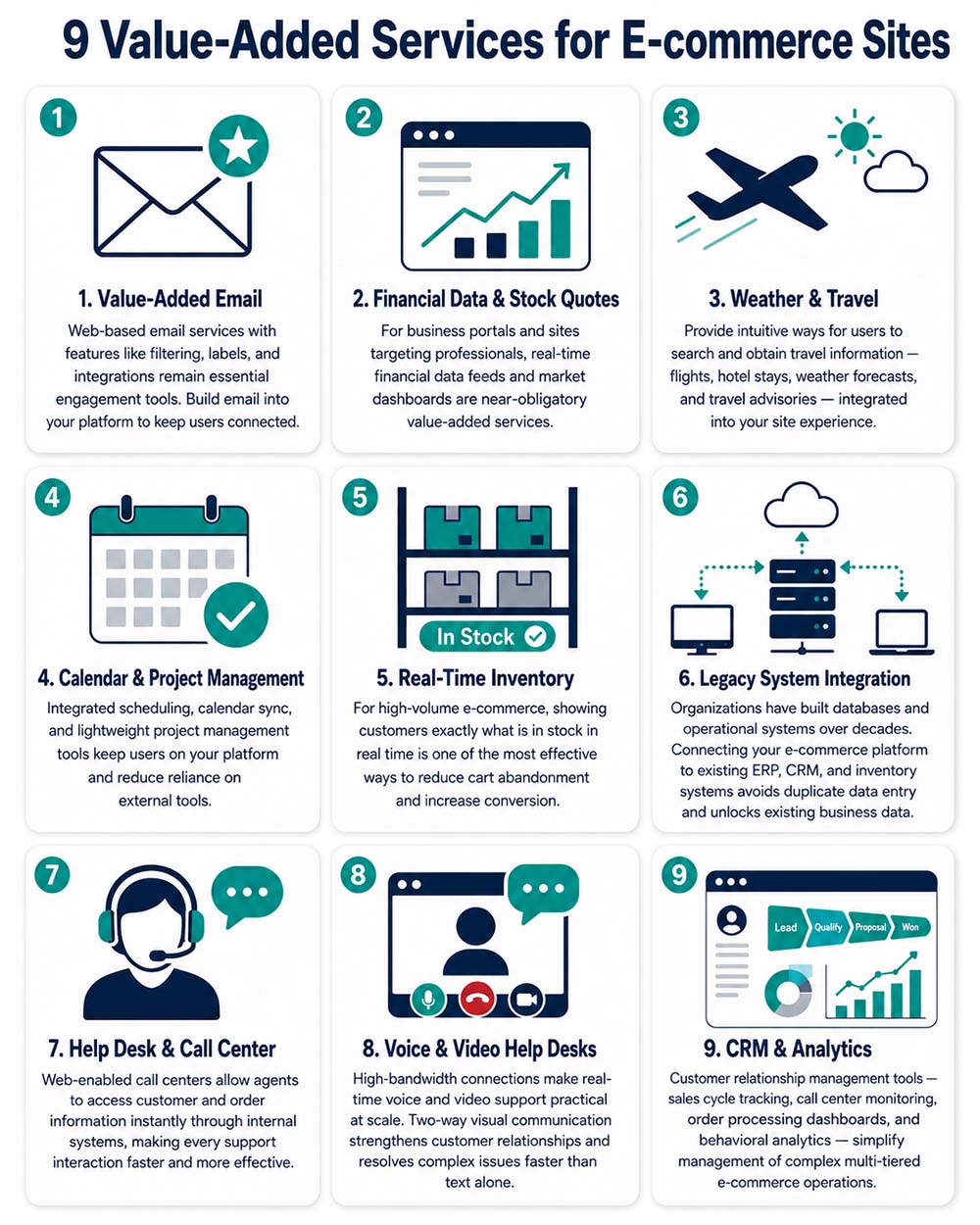
The nine services illustrated above address different aspects of customer engagement and operational efficiency:
- Value-Added Email — integrated email with filtering, labels, and integrations keeps users connected to the platform between transactions
- Financial Data and Stock Quotes — real-time market data is near-obligatory for business portals targeting professional or investor audiences
- Weather and Travel — travel search, hotel booking, forecasts, and advisories increase utility for travel-adjacent or lifestyle sites
- Calendar and Project Management — scheduling and task tools reduce reliance on external applications and keep users within the platform
- Real-Time Inventory — showing customers exactly what is in stock reduces cart abandonment and increases conversion confidence
- Legacy System Integration — connecting the e-commerce platform to existing ERP, CRM, and inventory systems eliminates duplicate data entry and unlocks decades of accumulated business data
- Help Desk and Call Center — web-enabled agents with instant access to customer and order data handle queries faster and more accurately than agents working from separate systems
- Voice and Video Help Desks — high-bandwidth connections make real-time voice and video support practical at scale; two-way visual communication resolves complex issues faster than text
- CRM and Analytics — sales cycle tracking, behavioral analytics, and order processing dashboards simplify management of complex multi-tiered e-commerce operations
CRM Applications
Take special note of CRM (Customer Relationship Management) applications. CRM software answers the fundamental operational questions of e-commerce: Who are your customers? How did they arrive? What did they do on the site? What did they buy? When did they leave? What brought them back? The answers to these questions determine the cost-effectiveness of the site, identify which customer segments are most valuable, and provide the data needed to improve conversion and retention.
Modern CRM and analytics platforms have extended well beyond the log analysis tools of the early web era:
Modern CRM and analytics platforms have extended well beyond the log analysis tools of the early web era:
- HubSpot — inbound marketing, CRM pipeline management, and customer lifecycle tracking with a widely used free tier
- Salesforce — enterprise-grade CRM with extensive customization, third-party integrations, and analytics across the full customer relationship
- Google Analytics 4 / Looker Studio — behavioral analytics, conversion tracking, and audience segmentation for web and app traffic
- Klaviyo / ActiveCampaign — e-commerce-specific CRM with purchase history segmentation, lifecycle automation, and revenue attribution
Business Models: B2B and B2C
Each of the archetypes discussed above operates within one of two fundamental business communication strategies. Determining which model applies before implementation shapes the archetype choice, checkout flow, pricing model, and integration requirements:
In the next lesson, you will develop a storyboard to outline your implementation plans.
- Business-to-Business (B2B) — transactions between businesses. B2B e-commerce typically involves higher per-transaction values, longer sales cycles, account-based pricing, purchase order workflows, and integration with the buyer's procurement and ERP systems. Transaction volume is often lower than B2C but average order value is significantly higher.
- Business-to-Consumer (B2C) — transactions between a business and individual end consumers. B2C e-commerce has higher transaction volume, shorter decision cycles, and lower average order values. Marketing emphasizes broad reach, brand awareness, and conversion rate optimization across the full purchase funnel.
In the next lesson, you will develop a storyboard to outline your implementation plans.
[1] Archetypes: Services and structural patterns that most e-commerce customers expect. These include the shopping cart, value-added services such as email and stock quotes, and help desk support — the standard elements that make a site feel immediately familiar and trustworthy from the first visit.