| Lesson 11 | Module 2 Conclusion |
| Objective | Summarize the key concepts of e-business architecture covered in Module 2. |
e-business Architecture: Module 2 Conclusion
Module 2 has covered the full span of e-business architecture — from the definition of the discipline itself through the frameworks, tools, and role distinctions that make architectural work tractable at scale. Ten lessons have built a progressive argument: architecture is not an optional refinement of engineering, it is the prerequisite for building e-business systems that can survive contact with real organizations, real stakeholders, and real change over time.
This conclusion draws the threads together, revisiting each lesson's core contribution and showing how they connect into a coherent body of practice.
What Architecture Actually Means
Lesson 1 established the foundational distinction that runs through everything that follows. When a marketing manager says "give a free book to anyone who buys ten books in a year," a developer hears an if-then condition. An architect hears a reusable pattern: value given to an entity when an event is triggered. That difference in abstraction level is not stylistic — it is functional. The developer's solution solves today's problem. The architect's solution accommodates tomorrow's variations without requiring a rebuild.
Architecture is about creating environments where disparate systems can operate together — not designing individual systems in isolation. The bricks-and-clicks model illustrated this concretely: a brick-and-mortar retailer moving online does not need a website, it needs an architecture that holds inventory systems, payment processing, fulfillment, customer accounts, and the digital storefront together as a coherent whole. The extra effort and expense associated with proper architecture almost always result in lower downstream operational costs and greater stakeholder satisfaction over time.
The Architect's Role and Skills
Lesson 2 defined what the architect actually does — and more importantly, what distinguishes the role from adjacent ones. The architect's defining responsibility is to reduce complexity and maintain the integrity and quality of the overall solution across its entire lifecycle. This requires operating simultaneously at strategic, technical, and operational levels: aligning e-business goals with organizational objectives, designing the platform architecture, selecting technologies, and ensuring that every component works together as a coherent whole.
The architect's skill profile spans four domains — personal traits, data architecture, application architecture, and technology architecture — but the common thread is generalism. The architect understands technology for what it can do and what it could do. They translate requirements expressed as specifications into the underlying objectives those specifications were trying to satisfy, and they are willing to return to stakeholders and explain when a requirement cannot be met as stated.
The five-step requirements process — take, business, requirements, plan, solution — governs this translation work. Requirements are almost always expressed as solutions. The architect's job is to extract the objective and validate that it is achievable within the constraints of the engagement. Solutions are mutually accepted compromises. The architect who executes this process well produces systems that are built to last, not just to ship.
Stakeholder Perspectives and Architectural Requirements
Lesson 3 established that architecture must be evaluated against stakeholder-defined criteria, not just technical correctness. In e-business, functionality is the minimum price of admission. Performance, experience, and differentiation are what determine whether users return and whether the business sustains competitive advantage.
Different stakeholder groups define success differently — a CFO's cost-per-transaction metric produces different requirements than a CMO's customer retention target. The architect must hold all of these perspectives simultaneously. Modern measurement frameworks make this concrete: Core Web Vitals (LCP, CLS, INP), customer acquisition cost, customer lifetime value, and Net Promoter Score are all shaped by architectural decisions made before any interface is designed.
Amazon's evolution from online bookstore to global ecosystem platform provided the module's most instructive case study in stakeholder-driven architectural decision-making. The architecture holds separate stakeholder experiences — Prime subscribers, third-party sellers, AWS enterprise customers, Alexa users — together without allowing them to collapse into a single undifferentiated product. Stakeholder perspective defines what differentiation means, and differentiation is the mechanism by which architecture creates competitive value.
Top-level Concerns of e-business Architecture
Lesson 4 catalogued the concerns that e-business architecture must address: reliability and scale, security and trust, integration and interoperability, and customer experience as an architectural requirement.
Scalability in 2026 means cloud-native patterns — auto-scaling groups, CDN edge caching, database read replicas, serverless burst compute — not static capacity planning. Business continuity means defined RTO and RPO targets, multi-region failover, and chaos engineering practices that validate recovery procedures before they are needed. Security means TLS 1.3, PCI DSS tokenization, zero-trust architecture, GDPR and CCPA compliance — not a firewall and an SSL certificate.
Integration and interoperability have shifted from point-to-point middleware to API-first architecture. REST and GraphQL for synchronous communication, webhook-driven event architectures for asynchronous communication, iPaaS platforms for SaaS connectivity. Every custom integration has a maintenance cost; every third-party dependency has a vendor risk. The architect who does not account for total cost of ownership during design produces systems that are technically correct but financially unsustainable.
Separation of Concerns
Lesson 5 showed how the architect manages the complexity that multiple stakeholder groups generate simultaneously. A brick-and-mortar retailer implementing an online presence faces seven simultaneous problems — one for each of Stores, Finance, Customer Service, Buyers, the Board of Directors, Merchandisers, and IT. Each problem is legitimate. Each has its own priorities. None can be subordinated to the others without consequence.
Separation of concerns is the method that makes this manageable. Separate UI design from business logic from data management from integration from security — each concern handled by the appropriate component, each component modifiable without cascading changes through the others. The architect determines boundaries: the level of granularity at which those boundaries are drawn depends on what the architect needs to reason about at a given stage. The ability to zoom out to system-level reasoning and zoom in to component-level detail without losing coherence is the defining skill of the effective e-business architect.
Quality Factors and Qualitative Requirements
Lesson 6 addressed the translation from qualitative stakeholder expectations to objective quality requirements — the core architectural skill that determines whether a system is built to the right standard or merely built. "The site should be fast" is not a requirement. "LCP under 2.5 seconds at the 75th percentile on a 4G connection" is a requirement. The architect's work is to move from the first statement to the second.
Quality factors are the performance metrics by which the solution is evaluated. High availability illustrates the cost dimension with particular clarity: 99.99% availability costs fundamentally more than 99.5% availability, and the architect must make that trade-off explicit using SLO, SLI, and error budget vocabulary that translates technical risk into business terms the Board and CFO can evaluate. Identifying quality factors early prevents conflicts later — conflicts that result in redesign, delays, and unhappy clients.
The shift to SaaS subscription models has changed the economics of software quality: when revenue depends on monthly renewals, customer churn is directly tied to product quality. DevOps and SRE practices have made continuous quality measurement standard. The historical excuse — that increasing quality does not increase profits — no longer holds in subscription-driven e-business.
Architects, Engineers, and Developers
Lesson 7 drew the distinction between the architect and the developer clearly: not a matter of seniority or technical skill, but of perspective and accountability. The architect looks at interfaces between the system and external entities, manages complexity, looks for emergent behavior, and uses qualitative characteristics as input to the architectural process. The developer is concerned with how the system operates within itself, matches the specificity within the design, focuses on planned behavior, and uses quantitative specifications as input to implementation.
The cautionary case study — a retailer who chose a platform because their developer was familiar with it, then discovered no tooling existed to interface with their product data system — remains the clearest illustration of what happens when a developer makes an architectural decision without architectural analysis. The three choices that result: manual process, custom tool that deepens lock-in, or start over. The answer: prevent the dilemma through solid up-front architecture.
These roles are not mutually exclusive. The same individual may function as architect during design and developer during implementation. What matters is that both perspectives are applied at the appropriate stages — and that the architectural outputs (API contracts, Architecture Decision Records, infrastructure-as-code, data contracts) are produced clearly enough to guide the implementation that follows.
Published Reference Architectures
Lesson 8 traced the history of reference models from the mid-1980s collapse of the mainframe through the OSI model (published 1984), TCP/IP, the Zachman Framework, the layer cake, and the BIT cube.
The OSI seven-layer model remains the primary conceptual model for inter-computer communications. Each layer provides services to the layer above and receives services from the layer below. Peer-layer interaction across the network allows network connections to operate without the upper layers. The TCP/IP model — four layers, no session or presentation — became the de facto applied standard through early DoD adoption and remains the deployed standard today, now extended with QUIC at the transport layer, IPv6 at the network layer, and SD-WAN and 5G NR at the interface access layer.
The Zachman Framework organized architecture by perspectives (owner, builder, subcontractor) and domains (data, function, network, people, time, motivation). The layer cake organized IT architecture into five layers from Technical Infrastructure to Business Architecture — useful for ERP thinking but limited for communicating with non-IT stakeholders. The BIT cube added scale and view dimensions but made the artifacts difficult to integrate as a continuous thread through business, information, and technology views.
The lesson from this history: creating separate business, information, and technology architectures in sequence no longer works in e-space. A decision about which commerce platform to adopt is simultaneously a technology decision, an information decision, and a business decision. The architect's framework must enable integration and automatic reconciliation across all three.
The IT Architecture Scale
Lesson 9 introduced the IT Architecture Scale as the reference model that reconciles the BIT approach with perspectives and domains. Seven levels organized along a single axis from Global and Partner Ecosystem Architecture (CTO's View) to Code and Infrastructure Build-Time Level (Individual Contributor's View). The directional logic is fundamental: the further left, the higher the abstraction and the broader the organizational perspective; the further right, the finer the detail and the narrower the implementation focus.
Each level has a defined audience (who consumes the artifacts) and a defined producer (who creates them). The Global level addresses partner ecosystem coordination — API gateway security policies, OAuth 2.0/OIDC for federated identity, ZTNA for inter-enterprise communication. The Enterprise level addresses data mesh architecture, ERP platform decisions, API management standards. The Domain and Solution Management level handles integration complexity within the enterprise. The Product and Service Application Framework level addresses functional suitability. The Platform and Component Framework level defines reconfiguration strategies — Spring Boot, Quarkus, React, Kubernetes operators. The Microservices and Service Level level addresses component isolation — Docker, Kubernetes pods, AWS Lambda. The Build level addresses delivery consistency — Maven, Gradle, GitHub Actions, Terraform, Pulumi.
The IT Architecture Scale succeeds where the layer cake and BIT cube struggled because it makes stakeholder perspective a first-class organizing principle — connecting each level to the organizational role that consumes it and the value it contributes to the business.
Creating a Matrix from Domains
Lesson 10 completed the transformation from BIT cube to deliverables matrix. When the cube is unfolded, the result is a two-dimensional grid: five rows (Business Architecture, Information Architecture, Application Architecture, Technical Application Services, Technical Infrastructure) crossed with seven columns (Global, Enterprise, Management, Point Solution, Framework, Micro, Build). Each cell contains the specific architectural artifacts produced at that intersection of domain and scale.
This is a deliverables matrix — not a RACI, not a traceability matrix, but a structured catalog of what gets produced at each combination of architectural scope and domain focus. A solution architecture is the path an architect traces through this matrix for a specific engagement. Not every cell is relevant to every project. The selected intersections define what gets produced, who produces it, and who consumes it — leaving a visible trail that documents the reasoning behind each decision and allows that reasoning to be traced from the global business driver that motivated a decision down to the build-level component that implements it.
Technology Leverage: From Architecture to Business Value
The relationship between business value and implementation time/cost for Internet technology investment follows a consistent pattern across industries and organizations. The diagram below illustrates this relationship across nine areas of process improvement, organized from lower business value and lower implementation cost at the bottom left to highest business value and highest implementation cost at the upper right.
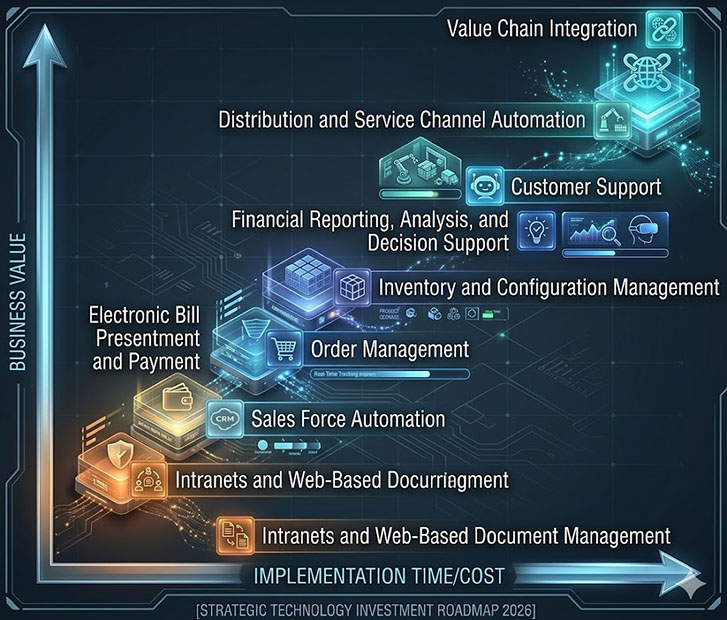
The nine areas, in order of increasing business value and implementation complexity:
- Intranets and Web-Based Document Management — replacing manual, paper-based processes with self-service digital workflows. Typically the first area where internet technologies are introduced, particularly in document-intensive industries: insurance, financial services, legal, healthcare. Low implementation cost, moderate business value — the foundation on which higher-value capabilities are built.
- Sales Force Automation — internet-based automation of information-intensive sales processes: prospect management, contract handling, custom pricing, deal tracking. Modern CRM platforms (Salesforce, HubSpot) and revenue operations tooling have made this capability accessible at scale. Delivers significant ROI through reduced sales cycle time and improved pipeline visibility.
- Order Management — electronic self-service ordering and digital catalog management. One of the most universally applicable capabilities, relevant to every company that sells products or processes claims. Modern order management systems integrate with ERP, fulfillment, and customer service platforms to provide end-to-end visibility from order placement to delivery.
- Inventory and Configuration Management — real-time inventory visibility and configuration management, particularly valuable for large multinational companies with complex product portfolios. Modern inventory platforms provide cross-channel inventory synchronization — the architectural requirement that makes BOPIS (Buy Online, Pick Up In Store) operationally viable.
- Electronic Bill Presentment and Payment — digital billing and payment capabilities, particularly valuable for telecommunications and financial services. Modern embedded payments (Stripe, Adyen, PayPal) and open banking APIs have made this capability significantly more accessible and reliable than the early internet era implementations.
- Customer Support — web-based self-service customer support integrated with knowledge bases and problem management applications. In 2026 this encompasses AI-powered chatbots, live chat platforms, omnichannel support routing, and self-service portals that deflect routine inquiries while escalating complex issues to human agents. High business value through cost reduction and customer satisfaction improvement.
- Distribution and Service Channel Automation — extranet-based systems for companies that sell through dealer networks, franchise systems, or broker networks. Modern equivalents are partner portal platforms and marketplace integrations (AWS Marketplace, Shopify Partner API) that provide partners with inventory visibility, ordering capability, and performance reporting.
- Financial Reporting, Analysis, and Decision Support — integrated reporting systems that provide decision makers with real-time or consolidated information customized to their role. Modern business intelligence platforms (Tableau, Power BI, Looker) and data warehouse solutions (Snowflake, BigQuery, Redshift) deliver this capability at scales that were not achievable in earlier internet generations.
- Value Chain Integration — the highest-value and highest-investment capability on the roadmap. Through end-to-end value chain integration, each point of information flow is optimized across all transaction points from the end customer up through all suppliers. Bidirectional, secure passing of quality data across the entire supply chain allows for substantial improvement of profitability by affecting multiple factors simultaneously: cost savings, increased sales opportunities, improved customer service, and reduced inventory carrying costs. Modern value chain integration uses EDI over HTTPS, supply chain APIs, and iPaaS platforms (MuleSoft, Boomi) to connect ERP systems with supplier and partner platforms — replacing the VPN tunnels and proprietary EDI connections of earlier decades.
The architectural implication of this roadmap is clear: higher-value capabilities require more complex architecture, longer implementation timelines, and greater investment in integration, data quality, and organizational change management. The architect who understands this relationship can set realistic expectations with stakeholders, sequence capability delivery to build on prior investments, and ensure that the architecture developed for lower-value capabilities does not foreclose the higher-value capabilities the organization will need later.
Module 3: The Evolution of Internet Technologies
Module 2 has provided the architectural foundation: the concepts, frameworks, roles, and tools that define how e-business architecture is practiced. Module 3 builds on this foundation by examining the evolution of the internet technologies that e-business architecture must work with — tracing how each generation of technology has created new capabilities and new architectural requirements, and how the current generation of cloud-native, API-first, and AI-enabled technologies is reshaping the e-business landscape.
To verify your understanding of the concepts covered in this module, take the end-of-module self-check quiz before proceeding.