Issues and Concerns in E-Business Architecture
E-business architecture is not only about building digital systems. It is also about identifying the issues and concerns that determine whether those systems will succeed in practice. A modern e-business environment connects customers, employees, managers, suppliers, partners, analytics platforms, inventory systems, databases, and digital interfaces into one operational ecosystem. Because these elements are tightly connected, a weakness in one area can quickly affect the rest of the business. For that reason, architects and decision-makers must do more than list technical components. They must outline the most important concerns, understand how those concerns affect stakeholders, and prioritize the risks that matter most.
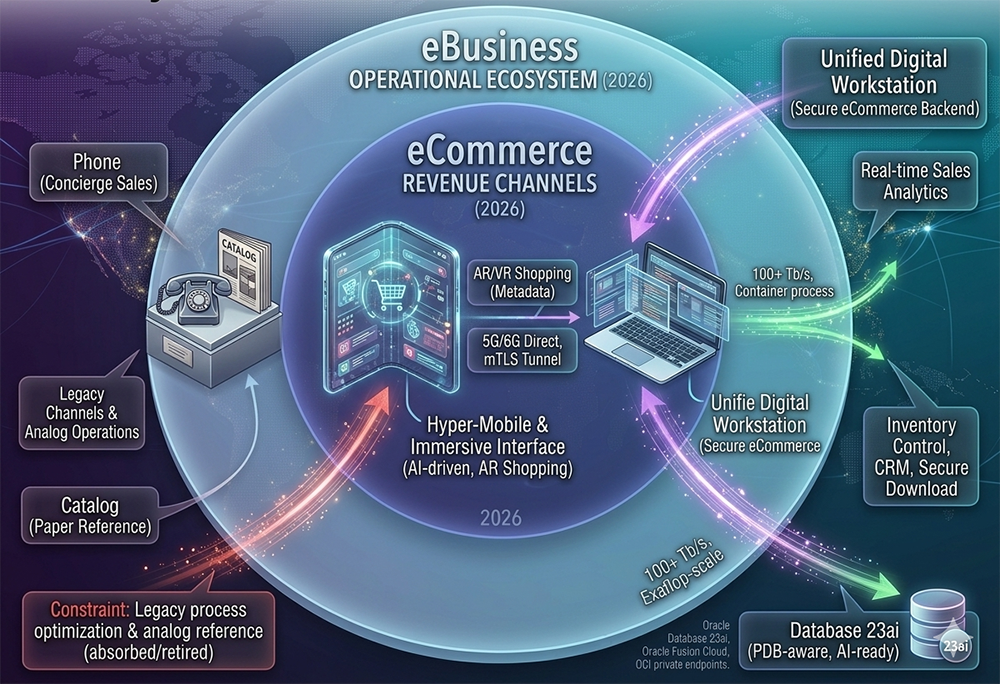
In earlier generations of web-based business, many organizations treated digital channels as isolated add-ons. A company might have maintained a paper catalog, handled phone orders manually, and then added a simple website without fully integrating it into the business. That model created duplicated work, fragmented information, and slow response times. In a modern e-business architecture, those older channels are either absorbed into the digital environment or retired. Customers expect real-time inventory visibility, secure transactions, personalized experiences, responsive interfaces, and reliable service across devices. Internal teams expect analytics, workflow automation, customer relationship management, and dependable access to operational data. These expectations raise the level of architectural responsibility. The architecture must support business goals, not just technical deployment.
One useful way to understand modern e-business concerns is to view the business as a layered digital ecosystem. At the center are the revenue channels that directly support online buying, digital engagement, and customer transactions. Around those channels is the wider e-business environment: analytics, employee workflows, customer support systems, partner connectivity, databases, governance processes, and operational controls. In this broader context, the key issues are not limited to “Can we build the system?” The deeper question is “Can we build a trustworthy, maintainable, scalable, and aligned digital business?” That is where architectural concerns become strategic concerns.
- What is the purpose of the e-business solution?
- What financial resources are available to pay for the development and ongoing license and operational costs of the solution?
- What human resources are available to develop and operate the solution?
- What existing system and operational constraints might affect the operability of the solution?
- What new systems components are available to assist in the design and construction of the solution?
- What user interfaces will be required?
- What are the management information requirements of the solution?
- What are the volume projections for the solution?
- What market research information is available?
- What will be the impact on other business operations of the introduction of the solution?
Why Prioritization Matters
Not every concern deserves the same level of urgency. Some issues can weaken efficiency, while others can threaten the entire digital operation. If an organization fails to prioritize correctly, it may spend too much time polishing low-impact features while ignoring the conditions that determine long-term survival. A sophisticated interface, for example, does not compensate for weak security, poor data quality, unreliable availability, or disconnected workflows. A good architectural review therefore separates concerns into levels of priority and evaluates them according to business impact, operational risk, stakeholder trust, and strategic relevance.
For modern e-business systems, the highest-priority concerns usually involve trust, continuity, and data integrity. These issues affect revenue, customer confidence, compliance exposure, and operational stability. The next level often includes stakeholder alignment and change management, because even well-designed systems can fail when departments, partners, or users are not coordinated. Lower-priority concerns are not unimportant, but they should be addressed after the more foundational risks are under control. This prioritization discipline allows the architecture to evolve in a realistic and sustainable way.
High-Priority Issue 1: Trust, Security, and Privacy
Trust is one of the most important concerns in e-business architecture. A customer may tolerate a visually plain interface for a short time, but very few customers will continue using a system that feels unsafe. If payment data, personal information, account credentials, or transaction records are exposed, the business suffers immediate reputational and financial damage. This is why secure architecture is not optional. It is foundational.
In a modern environment, trust includes several related concerns: secure payment processing, identity verification, encrypted communication, access control, fraud prevention, and responsible data handling. The architecture must protect transactions from interception and misuse. It must also support clear governance over who can view, update, or extract sensitive information. In practice, this means that payment systems, customer portals, mobile applications, analytics dashboards, and administrative workstations must all be designed with security principles in mind.
Privacy is closely tied to trust. Customers and regulators now expect organizations to justify how data is collected, stored, analyzed, and shared. An architecture that centralizes data without clear governance creates hidden risk. The more digital the business becomes, the more important it is to define data boundaries, minimize unnecessary exposure, and maintain auditable controls. A modern e-business architecture must therefore treat privacy not as a legal afterthought, but as an architectural requirement.
High-Priority Issue 2: Reliability and Operational Continuity
An e-business system cannot create value if it is unavailable when people need it. Reliability is therefore another top-tier concern. If a site cannot process orders, if the inventory view becomes stale, if customer support tools are offline, or if backend databases fail under load, the business loses more than convenience. It loses revenue, credibility, and momentum.
Operational continuity involves more than uptime percentages. It includes resilience under heavy demand, dependable failover behavior, recovery planning, and the ability to continue serving customers during partial disruptions. Modern businesses often depend on digital workstations, analytics platforms, integrated customer systems, and AI-assisted tools. This means a failure in one service can ripple into several others unless the architecture is designed for graceful degradation. The system should not collapse simply because one component is delayed or unavailable.
Reliability also matters internally. Employees and managers depend on accurate dashboards, partner portals, inventory controls, and workflow tools to make decisions. If those systems become unreliable, the business cannot coordinate its own operations effectively. In that sense, operational continuity is both a customer-facing issue and an internal governance issue.
High-Priority Issue 3: Data Accuracy, Quality, and Governance
Modern e-business depends heavily on data. Pricing, product availability, customer segmentation, forecasting, sales analytics, recommendations, campaign measurement, and partner coordination all rely on the assumption that the underlying data is current and trustworthy. If the data is wrong, the architecture becomes a machine for scaling mistakes.
Data quality problems can arise in many ways. Systems may be integrated poorly. Records may be duplicated. Product information may be inconsistent across channels. Customer profiles may become fragmented. Analytics pipelines may introduce delay or distortion. In some cases, the business may appear digitally advanced while still relying on disconnected spreadsheets, outdated manual corrections, or shadow systems. That situation creates a false sense of maturity.
Good architecture treats data as a governed asset. That means defining authoritative sources, validating critical information, coordinating updates across systems, and ensuring that analytics reflect operational reality. It also means giving decision-makers visibility into data lineage and reliability. If a manager is reading real-time sales analytics, that dashboard should be supported by disciplined data flows rather than optimistic assumptions.
Medium-Priority Issue 4: Stakeholder Alignment
E-business architecture affects many groups at once. Customers want convenience, clarity, trust, and responsiveness. Employees want systems that reduce friction instead of creating extra administrative burden. Managers want visibility, control, and measurable business outcomes. Suppliers and partners want consistent integration and predictable processes. Because all of these interests intersect, stakeholder alignment becomes an important architectural concern.
A common failure pattern occurs when architecture is designed from only one perspective. A technically elegant system may frustrate users. A customer-friendly front end may create chaos for back-office teams. A reporting platform may look impressive but fail to reflect operational needs. In each case, the architecture suffers because the stakeholders were not aligned around common priorities.
Architectural planning should therefore ask practical questions: Which stakeholders are affected? What do they need from the system? Where do their needs conflict? Which concerns are strategic, and which are merely preferences? By answering those questions early, an organization can avoid building systems that satisfy one department while weakening the larger business.
Medium-Priority Issue 5: Legacy Transition and Change Management
Many businesses still carry legacy habits even after adopting digital channels. Phone-based sales, paper catalogs, manual approvals, disconnected records, and analog reference practices may continue to shape how the organization operates. These legacy elements are not always useless; sometimes they preserve domain knowledge or serve specialized customer groups. However, they can also slow modernization and prevent the architecture from becoming truly integrated.
The issue is not simply whether legacy processes exist. The real question is how the organization will absorb, modernize, or retire them. If legacy processes remain outside the digital environment, they often create duplicate effort and fragmented information. If they are rushed into new systems without careful design, they may carry old inefficiencies into the new platform. Effective change management requires the business to decide which practices still provide value and which ones now function as constraints.
This is especially important in lessons about e-business concerns because digital transformation is not only technical. It is organizational. People must trust the new systems, understand the new workflows, and adapt to new responsibilities. Without that human transition, even a modern architecture can remain operationally immature.
Medium-Priority Issue 6: Complexity and Integration Overhead
Modern digital ecosystems often combine customer interfaces, analytics, mobile experiences, operational systems, partner access, and centralized databases. As capabilities expand, so does complexity. New channels such as immersive shopping, AI-assisted personalization, and real-time decision support can create competitive value, but they also add architectural overhead. Each new layer increases the need for coordination, observability, and disciplined integration.
Complexity becomes a concern when the business adds capabilities faster than it can govern them. An organization may accumulate multiple interfaces, dashboards, APIs, or data services without a coherent plan for ownership and interaction. At that point, the system becomes harder to maintain, harder to secure, and harder to explain. Complexity is not automatically bad, but unmanaged complexity is dangerous because it hides risk until the business is under stress.
This is why integration architecture must remain subordinate to business purpose. The goal is not to add technology for its own sake. The goal is to build only the level of digital sophistication that the business can support, govern, and turn into value.
Lower-Priority but Strategic Issue 7: User Experience and Emerging Interaction Models
As e-business evolves, organizations are exploring more advanced interaction models, including AI-guided experiences, immersive interfaces, augmented reality shopping, conversational systems, and highly personalized mobile journeys. These innovations can create differentiation, but they should not be mistaken for the foundation of the architecture. They are strategic enhancements, not substitutes for trust, reliability, and good data governance.
Emerging interaction models introduce their own concerns. Some users may find immersive experiences confusing or unnecessary. Others may have accessibility needs that are not well supported by visually rich interfaces. Businesses may also overestimate user demand for new experiences and underestimate the cost of maintaining them. Therefore, these features should be evaluated carefully in relation to actual customer value rather than novelty alone.
When introduced thoughtfully, modern interaction models can strengthen the business by improving discovery, engagement, and decision support. When introduced carelessly, they distract from more urgent priorities. A disciplined architecture treats them as optional layers built on top of a sound operational core.
A Practical Prioritization Model
One practical way to prioritize e-business concerns is to group them into three levels.
First priority: trust, security, privacy, operational continuity, and data accuracy. These are the conditions that keep the business viable and credible.
Second priority: stakeholder alignment, governance, legacy transition, and integration discipline. These determine whether the business can scale digital operations without internal fragmentation.
Third priority: advanced user experience layers, immersive interfaces, and experimental interaction models. These can add value, but only after the first two tiers are stable.
This kind of ranking helps organizations avoid confusion. It reminds teams that the most important architectural work is often not the most glamorous. Secure transactions, trustworthy data, and dependable operations are more important than impressive demos. The foundation must be stable before innovation can deliver lasting value.
Conclusion
To outline and prioritize key issues and concerns in e-business architecture, it is necessary to think beyond individual web pages or isolated technical components. Modern e-business operates as an interconnected ecosystem in which customers, employees, managers, partners, operational systems, analytics, and databases all influence one another. Within that environment, the most important concerns are trust, security, continuity, data quality, and stakeholder alignment. Legacy transition, integration overhead, and emerging interface models also matter, but they should be evaluated according to business impact rather than novelty.
A well-designed e-business architecture does more than digitize old processes. It creates a coordinated environment in which business goals, stakeholder needs, and modern digital capabilities are aligned. That is why prioritization is so important. By addressing the right concerns in the right order, an organization can move from fragmented digital activity toward a more reliable, scalable, and strategically grounded e-business ecosystem.
Issues Concerns - Exercise